The Underground Thomist
Blog
How Philosophy GoesSaturday, 08-23-2014
How Philosophy GoesSound philosophy originates in common experience and opinion. It is futile to seek proofs of such things as that we exist; that time passes; that I remain myself even if my hair changes color; that some things are good; or that good is to be pursued. But if philosophy draws itself from common opinion, then it is not at first clear how philosophy can go beyond it. Why not just bring in the man on the street and ask him what he thinks about things? In a way, that is exactly what philosophy does. Look how Aristotle investigates happiness, beginning with the common recognition that every act is undertaken for the sake of some end, and then asking questions about this end. Even his scrutiny of common opinions depends on common opinions, for he doesn't simply shoot arrows at them from on high. He makes them interrogate themselves. For example, one common opinion is that happiness is honor, the praise of other people. Do you say happiness is sought for its own sake? Yes. Then if happiness is honor, honor would be sought for its own sake, correct? Yes. Then would you be satisfied if other people praised you for qualities you knew you did not have? No; that sort of praise has no savor. But in that case, you don’t consider praise worth having for its own sake after all, do you? More fundamental is praiseworthy qualities. That is how philosophy goes. It can elicit what we didn’t know we knew – but we must already have known it. It can draw inferences -- but we must already grasp the consequence relation. It can call attention to inconsistencies – but we must already realize that contrary views cannot all be true at once. The idea is not to destroy common opinion, but to cleanse, extend, and ennoble it, by forcing it, through dialogue, to be honest with itself. |
It Was a Beautiful FightFriday, 08-22-2014It Was a Beautiful Fight
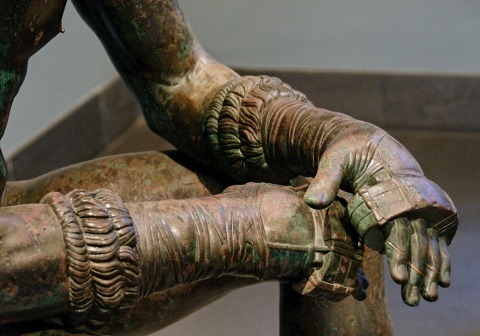
My father loved St. Paul, so all my life people have been quoting to me the apostle’s remark, “I have fought the good fight,” and his advice to the young Timothy, who stands for each one of us, to follow his example. It sounded starched and churchy. I wasn’t impressed. Blame the translation. The Greek phrase translated “good fight” is kalon agona. Thayer’s Lexicon translates the underlying word kalos as “beautiful,” applied to “everything so distinguished in form, excellence, goodness, usefulness, as to be pleasing.” So think of Paul as a champion prize fighter, climbing down from the ring after victory, gleaming with sweat, blood streaming from his nose, staggering but still on his feet. All at once, with broken lips and a mouth of loose teeth, he stops, looks at Timothy, grins and cries cheerfully, “It was a beautiful fight.”
|
Children Are Not Costs and BenefitsThursday, 08-21-2014
Children Are Not Costs and Benefits
The view that holds that all decisions should be guided by an aggregate cost-benefit analysis is spilling over from the government, military, social, and industrial bureaucracies to personal life. For an example of this utilitarian delusion, consider the remarks of one of its spokeswomen, Bernadette Young, about whether and when to have children. “In addition to straightforward financial outlay, parenthood comes with costs of time and opportunity. Loss of flexibility and leisure mean you won’t be able to take all opportunities (like taking on extra work to make more money or advance your career). Late notice travel is unlikely to be possible. You will probably be sleep deprived for a large part of the first year or more of your child’s life, and this may impact on your work performance. The work of parenting will take time, though some of it may be outsourced at the cost of increased financial outlay.” Are you surprised that she doesn’t suggest “outsourcing” conception and pregnancy too? She goes on to say, “I don’t have the answer to the origin of the longing for children that many experience. It’s almost certainly due to a complex mixture of biological and social factors. It might even be an evolutionary trick.” Someone should have told the author that we do not have children on the basis of rational calculation. We have them in hope. Not hope in the sense of blind optimism; I am speaking of the gift of God. Some also should have told her that having children is not about increasing the net balance of happiness over pain. Of course they are a profound source of joy, but what makes them so is that in giving ourselves to them, we are no longer thinking of our joy. We are thinking of them. Praise God for sleep deprivation. Praise God for all those other things that shatter our security and selfishness. Children are not a lifestyle enhancement; they are themselves. Of such is the kingdom of heaven. |
Peter Singer on Animal FarmWednesday, 08-20-2014 Recently, upon re-reading George Orwell’s penetrating fable Animal Farm, I was reminded of the enormously influential utilitarian bioethicist Peter Singer. Singer is one of the founders of the Animal Rights movement. One of his mottoes, and the title of one of his most famous essays, is “All Animals Are Equal.” This is also the culminating Seventh Commandment of the animals who drive out Farmer Jones, the drunken representative of humanity, and take over the farm for themselves. But there is a catch. As the pigs, the revolutionary leaders, tighten their grip on power, they secretly alter the Commandments during the night. “No animal shall sleep in a bed” changes to “No animal shall sleep in a bed with sheets,” since the pigs have become fond of laying on the farmhouse beds. “No animal shall drink alcohol” changes to “No animals shall drink alcohol to excess,” since the pigs have discovered that they like getting drunk. “No animal shall kill any other animal” changes to “No animal shall kill any other animal without cause,” because to protect their reign, the pigs begin a round of executions, and send injured animals to the knacker to be rendered into useful by-products. Professor Singer does not propose sending nonproductive humans to the knacker. But he might as well, because in the name of efficiency, he does think they ought to be euthanized. The paradox in his motto “All Animals Are Equal” is that by “equal” he doesn’t mean any of the things usually meant, such as “of equal essential worth” or “of equal inviolability.” He couldn’t; he doesn’t believe in things like essences, much less inviolability. All he means is that all animals with a sufficiently complex nervous system experience preferences and aversions. There is nothing special about the joy and suffering of rational beings like humans. But here is the catch: The preferences of some animals can be more important than the preferences of others. So Professor Singer reasons that perhaps we should not perform experiments on an adult chimpanzee for the benefit of others, because he would be aware of what was happening to him -- but we might perform them on a human infant. Preferably an orphaned infant, he says, because then the decision would not be complicated by parental feelings. I am not making it up; this is how establishment bioethicists talk these days. The upshot is that Professor Singer’s kind of equality is much like the kind we end up with in Animal Farm, when the pigs secretly change the Seventh Commandment to “All Animals Are Equal, But Some Are More Equal Than Others.”
|
Body and Soul UnityTuesday, 08-19-2014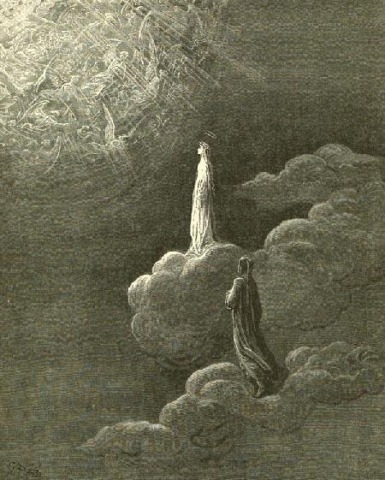 Query: Recently I watched the video of your talk to the Stanford Anscombe Society on The Meaning of the Sexual Powers. At several points during the talk, you mentioned that a human being is a “body and soul unity.” Have you written of this anywhere else? Could you explain? Reply: The specific points about body and soul unity that I made in the talk you heard are discussed more fully in my book, On the Meaning of Sex . But the premises of body and soul unity might be put briefly as follows. Neither body alone, nor soul alone, neither expresses the whole being of a human person. The body is a person’s material aspect, and the soul is his formal aspect -- that which makes the difference between a mere corpse and an embodied human life. Because both of these are bona fide aspects of the human person, my body is just as human and personal as my soul, and my soul just as human and personal as my body. “The real me” is both of them together. Moreover, neither body nor soul is reducible to the other. It would be profoundly mistaken to think that the human person is really nothing but a body, and that the soul is merely one of its parts, properties, or activities. It would be equally mistaken to think that the human person is really nothing but a soul, and that the body is merely its tool or container. I try to avoid the expressions “monism” and “dualism,” because I’ve found that they are used in overlapping senses which often given rise to confusion. If monism is taken in the common sense of claiming either that the human person is either only a soul or that it is only a body, then body and soul unity is not monist. But if dualism is taken in the equally common sense of denying that the two elements, soul and body, form a genuine composite in the human person, then body and soul unity is not dualist either. Another term for body and soul unity is “hylomorphic” unity. This classical view of the human being is epitomized by Aristotle among the Greeks, and, with differences, by Thomas Aquinas among the Christians.
|
Why We Should Love the University of SalamancaMonday, 08-18-2014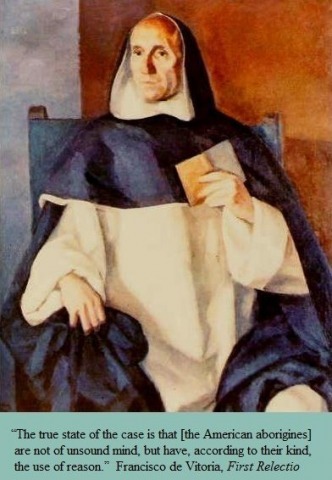 “I love the University of Salamanca; for when the Spaniards were in doubt as to the lawfulness of their conquering America, the University of Salamanca gave it as their opinion that it was unlawful.” -- Samuel Johnson, in James Boswell, Life of Johnson
|
IncarnationSunday, 08-17-2014Incarnation“The Maker of man became man that He, Ruler of the stars, might be nourished at the breast; that He, the Bread, might be hungry; that He, the Fountain, might thirst; that He, the Light, might sleep; that He, the Way, might be wearied by the journey; that He, the Truth, might be accused by false witnesses; that He, the Judge of the living and the dead, might be brought to trial by a mortal judge; that He, Justice, might be condemned by the unjust; that He, Discipline, might be scourged with whips; that He, the Foundation, might be suspended upon a cross; that Courage might be weakened; that Security might be wounded; that Life might die. To endure these and similar indignities for us, to free us, unworthy creatures, He who existed as the Son of God before all ages, without a beginning, consented to become the Son of Man in these recent years. He did this although He who submitted to such great evils for our sake had done no evil and although we, who were the recipients of so much good at His hands, had done nothing to merit these benefits.” -- Augustine of Hippo, Sermon 191
|