The Underground Thomist
Blog
Put Them to WorkMonday, 05-24-2021
When a couple with their six fine children accepted our invitation to have dinner with us, my wife and I were charmed by the cheerful courtesy of their oldest daughter. “Without a doubt,” we told her, “you’re the politest teenage girl who has ever visited our house.” She laughed. “Since I’ve been working at Chick-fil-A, I talk that way to everyone.”
|
OverheardMonday, 05-17-2021
Also:My new article in Public Discourse,Between Man and Man: Friendship,Law, and the Common GoodYounger woman to older woman (referring to her child): He’s reading about Rosa Parks. Child to older woman: Were you against that then? Older woman: Against what, honey? Do you mean racial segregation? Child: Yes. Older woman (convert from progressivism): Oh, yes, I was always against it. Younger woman (convert to progressivism): Separate but equal. That never worked, did it? Older woman: No, I was against it then and I’m against it now. Younger woman: What do you mean, against it now? Older woman: The races are being separated again all over the country. I’m against that. Younger woman: What are you talking about? Older woman: Well, Columbia University has separate graduation ceremonies for blacks and Hispanics.* And that sort of thing is happening all over. Dormitories too. Younger woman (skeptically): I haven’t heard anything about that. (Younger woman changes the subject. Transcript ends.) Progressives, do you really not know that what your movement now stands for in the name of antiracism is racism? __________________ * She was right. In a textbook example of doublespeak, Columbia University says that the six segregated ceremonies -- Native, Asian, Black, “Latinx,” “Lavender,” and “First Generation or Low Income” -- are not really segregated because no one is forced to attend one of them and there is also a campus-wide ceremony. In other words, they are segregated, but there is no enforcement because the graduates are encouraged to segregate themselves.
|
FragilityMonday, 05-10-2021
The mental composure of a great many university students these days is fragile. You would be surprised by how many miss classes, and how many classes they miss, because of depression or anxiety. Student health administrators send letters to faculty asking them to excuse the absences of perturbed students, allow them extra time on tests, and make a variety of other accommodations for them, because their discomposure is considered a disability. For that matter, the equanimity of a lot of other citizens is pretty fragile too. They were anxious before the epidemic. They have been anxious because of the epidemic. According to therapists interviewed by the Wall Street Journal, now some of them appear to be anxious because the epidemic is tapering down. Its windup hints at the possible loss of rules that not only soothe and comfort them, but also reassure them that their anxieties are appropriate. I don’t write to criticize them. The appropriate response is compassion. But theirs are not ideal frames of mind for the continuance of a university, or for that matter of a republic. The pursuit of learning, like the pursuit of the common good, requires a certain calm, toughness, resistance to panic, and ability to function without being told what to do. These students and fellow citizens need the encouragement of the rest of us to get better. In a thousand ways, though, the kinds of “help” that many counselors and politicians offer tends to make them more anxious and dependent still. There are reasons for that, but they lie less in those who turn to these counselors and politicians than in the counselors and politicians themselves. That very large topic is for another day.
|
Divine Law ExplainedMonday, 05-03-2021
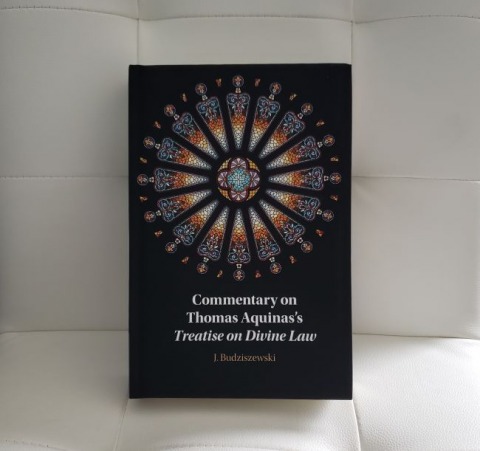
Gentle readers, It gives me delight to announce that Cambridge University Press has just published my new Commentary on Thomas Aquinas’s Treatise on Divine Law. I dealt with Divine law just a little bit in my earlier Commentary on Thomas Aquinas’s Treatise on Law, but this time I am focusing on the sections of the Summa that are all about Divine law. To do that in the original commentary would have more than doubled the book. Not a good idea. The book is aimed at students, at scholars – and yes, it should work fine in the classroom! -- but I always try to write in such a way that anyone who is interested can read, understand, and, I hope, enjoy. And I really do mean anyone: Please don’t think the book is only for Catholics, only for Christians, or even that it is only for people who believe in God. There is no need to pretend that conversation among a Christian, a Jew, a Muslim, and an atheist is an easy undertaking. However, the attempt is much more fruitful – and far more interesting -- if the Christian, the Jew, and the Muslim are not required to impersonate the atheist. I hope the book will be read by people interested in all sorts of things: Ethics, law, political theory, jurisprudence, theology, psychology, and others. Crucial to this hope is the fact that although St. Thomas does make use of Holy Scripture, he doesn’t just thump it and say “The Bible says!” He offers philosophical arguments for such things as the reality of God, and he makes further use of the tools of reason to investigate what he believes God has revealed. It is curious how often even Christians assume that one must already be Christian to be interested in what St. Thomas has to say. I confess that this seems irrational to me. Christians read books by atheists; why shouldn’t even the most resolutely secular reader engage with a thinker like St. Thomas?
ENDORSEMENTS “This commentary on Aquinas's treatise on the Divine Law is a worthy and, indeed, indispensable sequel to the author's prequel, his successful commentary on Aquinas's Treatise on Law, in which the focus was law in general, eternal law, natural law, and human law. The sequel expands into a lucid treatment of the revealed divine law, old and new, in all its complexity. Directed primarily at those who study this demanding and difficult treatise for the first time but also instructive for the seasoned scholar, Budziszewski offers the first English-speaking commentary on the divine law in more than one generation. Clearly organized and lucidly written, this is an invaluable resource for every student of Thomas Aquinas, especially neophytes to Aquinas’s thought, be they seminarians, undergraduate and graduate students, or the proverbial layperson who is looking for a reliable guide into Aquinas's teaching on the divine law.” Reinhard Huetter, Ordinarius Academician of the Pontifical Academy of St Thomas Aquinas “Having already provided us with a complete commentary on Aquinas' treatise on natural law, J. Budziszewski here adjoins an accessible and nuanced analysis of Aquinas on the Old and New Law. The author directly engages with contemporary questions regarding the reasonableness of biblical revelation, its historical situatedness, the intellectual viability of its claims to uniqueness, and the challenges of its contemporary interpretation. In the spirit of St Thomas this is an impressive work of both reason and faith, philosophy and theology, one that contributes substantively to the Thomistic commentarial tradition. It serves as an important testimony to a culture of universal ethics that simultaneously bears the marks of a Christian conception of love.” Thomas Joseph White, Thomistic Institute “J. Budziszewski's Commentary on Thomas Aquinas's Treatise on Divine Law contains the best available commentary and introduction to this section of Summa theologiae. Budziszewski masterfully glosses Aquinas with insights that seasoned scholars will appreciate and a clarity that readers new to Thomas will cherish. If you want to understand what Thomas taught about divine law, you need to read this book.” Christopher Kaczor, Loyola Marymount University “J. Budziszewski's Commentary is an impressive achievement! It belongs on the shelf of every serious reader of Aquinas's treatment of law, politics, and justice. He has brought back a classic form of Thomistic scholarship – the commentary on Aquinas's Summa Theologiae – but with a thoroughly contemporary twist. He brings alive the issues at stake in Aquinas's texts, with an admirable clarity of exposition. It is both accessible to a newcomer and offers fresh insights to experts.” Dominic Legge, Thomistic Institute and the Pontifical Faculty of the Immaculate Conception “This brilliant commentary will be extraordinarily helpful not only to students, but to scholars – even seasoned readers of Aquinas who imagine that they already know his treatise on divine law. What is especially striking about Budziszewski's achievement is his ability to convey the spiritual serenity and reasonableness that characterize Aquinas's thought. Budziszewski captures these qualities through his own limpid and colloquial explanations, thereby bringing Aquinas's text to life.” Matthew Levering, Mundelein Seminary “J. Budziszewski has earned a reputation for scholarly excellence among serious students across several disciplines. His many published works further testify to his craftsmanship. Although he works as a professor of government and philosophy at the University of Texas, Budziszewski also enjoys standing among theologians. Scholars amenable to the thought of Saint Thomas Aquinas especially rely on Budziszewski's remarkable capacity to sum up complicated debates and doctrines. The present work fills a pressing need. One does not arrive easily or quickly at what Aquinas, whose name adorns Harvard Law School's walls (along with the great legal minds Harvard esteems), teaches about law. This book contains judiciously selected texts from Aquinas's works along with copious exegetical and explicative notes that open up his mind on divine law. A careful study of this volume will reward all readers, especially those who have been trained to think that laws are commands of human beings – only.” Romanus Cessario, O.P., Ave Maria University “J. Budziszewski's commentaries on Thomas Aquinas's Summa are the best I have ever read. Like each of his two earlier commentaries – on the Treatise on Law and on Aquinas' Virtue Ethics – this present volume on the Divine Law is as accessible to the novice as it is rich with insight for the scholar. In the insular worlds of academic philosophy and theology – especially among the disputing factions in the world of professional Thomism – it is rare to find a writer who has the ability to cut through the jargon while not losing an ounce of sophistication. For anyone who wants to explore Aquinas on divine law, I can not think of a better companion with which to take that journey than Budziszewski.” Francis Beckwith, Baylor University “J. Budziszewski has a rare talent for producing work that is simultaneously accessible and philosophically substantive, and thereby brings classic works and authors alive for a contemporary audience. Students and professors alike will read this commentary with profit.” Edward Feser, Pasadena City College “Professor Budziszewski’s commentaries on Aquinas’ treatises are a unique resource. He is a friendly and expert guide to Aquinas’ text, method and world, putting us at our ease in what can seem a strange landscape, and empowering us to explore it further. He makes everything clear by explaining terms, unpacking arguments, and offering analogies. This commentary fills a long-standing gap, since Aquinas’ Treatise on the Divine Law is relatively neglected, yet is essential for understanding his teaching on Natural Law, on legislators’ tasks, and on the Spirit’s role in Christian life. It is an important part of the reception-history of the Bible. A knowledge of Aquinas’ positive attitude towards the Torah can contribute to Jewish Christian dialogue. Budziszewski has done an invaluable service to scholars, students and ‘interested amateurs’ of many backgrounds and many disciplines.” Richard Conrad, University of Oxford
SUMMARY To cover every single Article of every single Question in St. Thomas’s Treatise on Divine Law would take three or four volumes, so I have been selective. Preliminary Considerations Question 91, Article 4: Is the Divine law a distinct kind of law, alongside what St. Thomas calls the eternal, natural, and human laws -- or is it merely a rehashing or recapitulation of one of the other kinds of law? Does it provide anything that the other kinds don't? After line-by-line commentary, more discussion is provided about Relation between Natural and Divine law . Question 91, Article 5: According to the tradition, there is more than one Divine law, for there is the law of the Old Testament, called the Old Law, given to the chosen nation, the Jews, and the law of the New Testament, called the New Law or the Law of the Gospel, given to the Church. One might hold that there could not have been two laws, because God would have done just as He intended to do the first time, or that the Old and New Law are not two different laws, but two different promulgations of the same law. Is this the case? Or are they somehow different? After line-by-line commentary, more discussion is provided about these topics: (1) Revelation – Says Who? (2) By No Other Name than Christ? The Old Divine Law, or Torah Question 99, Article 2: According to an influential argument, the Old Testament law included three different kinds of precept: Moral, ceremonial, and judicial. Is this classification correct? At first, the question would seem to be easy to answer: Just look and see whether there are any moral, any ceremonial, or any judicial rules. However, the “look and see” approach begs the question of which rules are of which kind. After line-by-line commentary, more discussion is about these topics: (1) How Many Kinds of Precepts Are There? (2) Correcting Aristotle . Question 99, Article 4: Judicial rules should be of broad interest, even among those who do not share St. Thomas’s faith tradition, because they concern rulers and governance, relations among citizens, relations with foreigners, and relations among members of the household. After line-by-line commentary, more discussion is provided about this topic: What Difference Does It Make? Question 99, Article 6: Although the Old Law is rich with promises of blessings in the present life for obedience to God’s law and warnings of calamities for faithlessness, in this respect the New Law is quite different. Yet the claim is that both laws come from God. What is going on? St. Thomas believes that although God devised the best law possible given the initial condition of the Hebrew people, His intention in giving them the law was not that they remain in this condition, but that they advance – that their minds be more faithfully shaped by His. After line-by-line commentary, more discussion is about these topics: (1) So What Are These Promises and Threats? (2) Does the New Law Also Contain Promises and Threats? Question 100, Article 1: If all of the moral precepts of the Old Law belong to natural law, then we could have known them all by reason alone. In that case, why was it necessary for God to add words? But if any of the moral precepts of the Old Law do not belong to natural law, then they would seem arbitrary to us -- unintelligible decrees without any basis other than that they were decreed. In that case, how could they count as true law? For in order to be true law, doesn’t an edict have to be recognizable as an ordinance of reason? After line-by-line commentary, more discussion is provided about this topic: Does What Holds for the Old Law Hold for the New Law Too? Question 100, Article 5: In the present Article, we are concerned with the Decalogue, which is a summary of the Law. At first glance, what these Ten Commandments include and leave out might seem a bit quirky. For example, since we are forbidden even to consider possessing our neighbor’s wives and husbands, why aren’t we forbidden even to consider lying and murdering, acts that are also wrong? After compiling a thorough list of such puzzles, St. Thomas shows that far from being arbitrary or idiosyncratic, the Commandments are organized and systematic. After line-by-line commentary, more discussion is about these topics: (1) The Moral Architecture of the Decalogue. (2) The Rest of the Moral Precepts .. Question 100, Article 7: Certain principles of composition apply with equal force to each of the Commandments. At stake is whether the Decalogue is just a collection of good ideas, haphazardly expressed, or a clear and systematic body of principles truly sufficient to serve as the foundation of the Old Law. After line-by-line commentary, more discussion is provided about these topics: (1) Sins of the Fathers; (2) Does the Old Law Recognize the Natural Law? Question 100, Article 8: A precept is “dispensable” if the authority that issues it can allow an exception to the duty of obedience. Are the Ten Commandments dispensable? For example, could any person ever be allowed to dishonor his parents, steal or murder, or be unfaithful to his wife? After line-by-line commentary, more discussion is provided about these topics: (1) False Difficulties. (2) Real Difficulties. Question 100, Article 9: I may perform a just deed because it is ingrained in me to do the right thing the right way – but I may also perform it merely because people are watching. Does the law require only that certain things be done? Or does it also require that they be done “according to the mode of virtue” – in the way that a just person would perform them? After line-by-line commentary, more discussion is provided about this topic: Do Legislators Really Aim at Making Men Virtuous? Should They? Question 100, Article 10: We have already considered whether the precepts of Divine law require doing the deeds that they perform as a virtuous person would perform them. However, the complete development of the virtues lies in that loving friendship between man and God which is called charity. In fact, without charity, even the ordinary moral excellences are virtues only “in a restricted sense,” because although they direct us to good purposes, they do not have the power to place these purposes in right relationship to our ultimate purpose, which is God. These facts force us to broaden our inquiry. If even acts of virtue are not all that they should be unless motivated by charity, then do the precepts of Divine law require acting from this motive? After line-by-line commentary, more discussion is provided about this topic: Love Is Complicated. Question 100, Article 11: Besides the Ten Commandments, the Old Testament contains a host of other moral precepts. Were they really needed? Why isn’t the Decalogue enough? Unlike the previous two Articles, which focus on the manner in which the Law must be followed, this one focuses on its architecture: On the relation among love of God and neighbor, the Decalogue itself, and all the other Old Law moral rules. After line-by-line commentary, more discussion is provided about these topics: (2) Is “Determination” Arbitrary? (2) False Teachers Question 100, Article 12: The question of this Article is whether a person can earn his way into God’s approval by doing the sorts of good “works” or deeds which were commanded by the Old Law. One of the difficulties theologians confront is that some New Testament passages seem to suggest that obedience to the Law’s moral precepts does have the power to do this, but others seem to suggest that it does not. How we can be justified – how we can be made just in God’s sight and acceptable to Him – is one of the great doctrines of Christianity, and was also one of the great fault lines during the Protestant Reformation. After line-by-line commentary, more discussion is provided about this topic: St. Thomas and the Reformers. Question 102, Article 1: The vast majority of the ceremonial precepts are what St. Thomas calls “determinations” of the three Commandments of the Decalogue concerning the worship of God. In his view they do not depend on “the very dictate of reason,” because although it could not be other than right to worship God, He might have enacted different modes of worshipping Him. But this fact does not imply that there were no reasons for enacting these modes rather than others. Were there such reasons? Or did the Divine legislator flip a coin? After line-by-line commentary, more discussion is provided about these topics: (1) So What Was the Problem with Mixing Linen with Wool? (2) Another Example: Avoiding Blood. (3) Can Anything Still Be Learned from the Ceremonial Precepts? (4) Does God Have a Sense of Humor? (5) Does St. Thomas Have a Sense of Humor? Question 105, Article 1: St. Thomas holds that although the ceremonial precepts of the Old Law passed away with the coming of Christ, their underlying rationale continues to have much to teach us. This is even more true of the judicial precepts, which were the civil law of the ancient Jewish people, a commonwealth of human beings united under God. The first category of judicial precepts is “precepts concerning rulers,” which is almost equivalent to what we call “constitutional laws.” The Israelite community had the special characteristic of being united in subjection to God – as all communities ought to be -- but most of what we find here has implications for any community whatsoever. After line-by-line commentary, more discussion is provided about these topics: (1) What St. Thomas Really Means by Kingship. (2) The Peril of Tyranny. Question 105, Article 2: Having considered the reasons for the rules about the structure of governance, St. Thomas now turns to the reasons for the rules about the relations among members of the community. Because this Article is extremely long, I have summarized the Objections and Replies, devoting the usual line-by-line commentary only to the sed contra and the respondeo. After line-by-line commentary, more discussion is provided about this topic: (1) Commonwealths Considered Ideally and Considered as They Are in Real Life. (2) On Whether the Lower is Really the More Solid. Question 105, Article 3: Besides addressing relations among persons of the Chosen Nation, the Old Law also addressed their relations with foreigners, or “strangers,” both inside and outside their borders. Some of these aliens were friendly, others hostile. Some lived in the cities and towns of other lands, some were sojourners passing through the land, and some, though not Israelites, were residents of the land. After line-by-line commentary, more discussion is provided about these topics: (1) Building Families and Transmitting Faith. (2) Harm to Innocents. The New Divine Law, Or Law of the Gospel Question 106, Article 1: St. Thomas argues that although in one sense the New Law is a written law, something outside of us, in another sense it is the very grace of the Holy Spirit, instilled into us. The latter sense is primary, but surprisingly, this does not make the former sense superfluous. We still need written instructions too. After line-by-line commentary, more discussion is provided about these topics: (1) The Relevance of the Gospel to Philosophy. (2) The Relation Between Nature and Grace . Question 106, Article 2: In some places the New Testament plainly speaks of justification as the beginning of the process of becoming just; in other places as its continuation, lest it be lost; and in still other places as its fulfillment. Not only does the God of Truth declare His followers just, but also, through the perfect integrity of the Savior with whom He joins them, He makes them just. St. Thomas considers Objections from various points of view, exploring how this could be. This Article should be read together with Question 100, Article 12. After line-by-line commentary, more discussion is provided about these topics: (1) The Letter That Kills. (2) The Scandal of This Teaching. Question 108, Article 4: The Tradition has always distinguished between precepts and evangelical counsels. The precepts are the moral commands of the Decalogue, interpreted in the light of the New Testament teaching about love. These are utterly necessary for entering into redeemed life. The counsels, such as perpetual poverty and perpetual virginity, are directions for those who wish to progress even more swiftly and with a minimum of distractions to the fullness of that life. Is this distinction reasonable? Considering certain remarks of Christ Himself, the answer would seem to be “Yes.” On the other hand, over the course of history many have answered “No.” St. Thomas considers the objections and proposes solutions. After line-by-line commentary, more discussion is provided about these topics: (1) Does the Recommendation of Perpetual Virginity Imply that Marriage Is Bad? (2) The Evangelical Counsels as the Foundation of the Consecrated Religious Life . Afterword: Implications of St. Thomas’s Teaching for the World of the Present By the light of natural law, even nations that have never heard of Divine Law may be able to achieve more or less decent rules of conduct and systems of civil law. Yet apart from grace, in our fallen state we fall far short of admitting what in principle we are capable of knowing, and doing what in principle we are capable of doing. We need Divine guidance to mend and correct us. Why then does the very mention of such guidance arouse such strong resentment? Can this resentment be overcome?
|
The World Is Not a VillageMonday, 04-26-2021
We assume that villages expose us to a narrower spectrum of life than cities do. G.K. Chesterton claimed that villages actually expose us to a far broader one. In fact, one of the things we like about cities is that they don’t expose us to a broad slice of life, and this is bad for us -- because we never have to learn to get along! No, he wasn’t deluded about villages. The solution to the paradox is that although a village might contain fewer sorts of personalities, in a city it is easier to avoid personalities we don’t like. There are so many of them in the city that we can pick and choose: Stockbrokers can spend time only with stockbrokers, bookworms with bookworms, single people with single people, drunks with drunks. Except for mundane necessities of life such as buying groceries, we can limit our contact to persons who are just like us. So much for Chesterton. Are you waiting for my own point? It’s this. One often hears that the rise of social media has turned the whole world into a village. In reality it has turned the whole world into a city. Now, even persons who don’t physically live in cities can find enough people like themselves online to form narrow, self-reinforcing cliques and associate only with those who are in them. At last, one of the moral disadvantages of city life has become nearly universal!
|
Divine ComedyMonday, 04-19-2021
Since God’s mind is in no danger of breaking from tension, He has no need to frolic, and since nothing can take Him by surprise, it might seem that He would take no interest in humor. If that’s how it is, I wonder why He created rational beings who do have a sense of humor. Besides, for someone who doesn’t need to hear jokes, He surely cracks a lot of them, as when he asks at Job’s expense, “Can you draw out Leviathan with a fishhook?” Nor is His humor just in words. If one of the reasons for making ants was to reprove sluggards with the spectacle of diligence, and one of the reasons for making stars was to fill our minds with awe for the Divine power and artistry, then is it too much to suggest that one of the reasons for making apes and monkeys – or even, as some think, to make us from them -- might have been to humble and amuse us? Besides, He enacts comedy in history: Not only in the sense that for all its sorrow, He has ordained a happy ending, but also in the details. Really, now -- “the last shall be first, and the first last”? What more unexpected, what more divine comedy could there be than that? Even though the discrepancy does not catch Him by surprise, He plainly enjoys it. If we never laugh with joy about His arrangements, we are missing something. Related:The Test of HumorAnnals of LimerickShaggy Dogs and HistoriansWhy Only Human Beings Laugh |
A New Mirror for PrincesMonday, 04-12-2021
Thomas Aquinas distinguished between everyday tyranny, which merely neglects the common good, and extreme tyranny, which, in the name of something or other, attacks it. Though one should always hope for better, I would say that everyday tyranny is pretty much the norm in most times and places. The great challenge is to resist the onset of the extreme sort, which in our day tends to have an angry but utopian tinge. I neither expect nor demand a classless society. I do cherish a few modest hopes: That the ruling classes not be so ossified and self-perpetuating as to resist the circulation of new elements into their ranks, and of old elements out of them. That they not be so secure in their position that they can hold common people in utter contempt. That they not be too clever at disguising such contempt as service to the masses. That they not believe too much in their own virtue. However, that they believe in the reality of virtue, recognizing the age-old morality they did not invent, even if they do not practice it personally. That's actually quite a lot, and more than we enjoy at present. It would help, I think, to teach it. I would love to see a comeback in the genre of literature that did, which in much earlier times was called Mirrors for Princes.
|