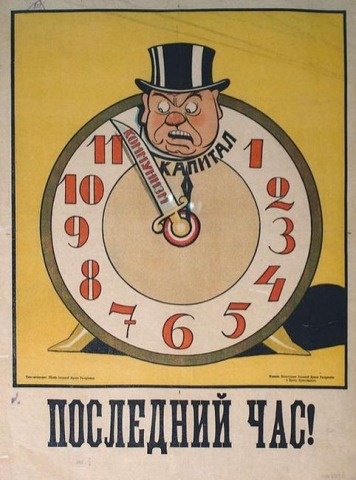
One grows so weary of socialism being touted as the meaning of the Gospel. We see this in the secular world, of course. But we also see it in liberal Protestantism, and in certain Catholic circles too. This is especially awful because it is, in the literal sense, a heresy. It isn’t compassionate, and it has nothing to do with the Gospel.
“Nothing to do with it? How can you say that?” To answer the question with a question: Can you tell me where the Gospel says it is wrong for anyone to have more or less than another? You can’t. The Gospel praises generosity and warns against the love of money, but what it condemns isn’t inequality of wealth per se, but exploiting and neglecting the poor – “the widow and the orphan,” who have no one to provide for them.
Much of what government does today in the name of caring for the poor actually hurts them, but that is a story for another day. I was talking about inequality.
The common assumption is that the poor are poor because other people are rich. Therefore, if no one was rich, no one would be poor. For example, a recent article in the Vatican newspaper L’Osservatore Romano laments that the wealth of those it considers super-rich “would be enough to eliminate extreme poverty in the world 26 times.” In case you’re wondering, that article is what lit the fuse for this post.
Never mind whether the statistic is accurate. Does the author really suppose that simply transferring money from haves to have-nots will eliminate poverty? And does he really suppose that the poor in poor countries are the ones who would get the transferred money?
How tempting to think so. It would be so easy! Just take it away from the rich people and give it all away! And since most of us aren’t rich (I’m not), thinking so makes us feel wonderful. But it’s false.
If the rich use their wealth in a way that promotes economic development, then by doing so they help the poor. Needless to say, they might not use their wealth in that way, but in a capitalist economy, it is in their interest to do so. On the other hand, if the poor remain untrained and uneducated, with unstable marriages and family structures, without opportunities and incentives for employment, they will remain poor no matter how much money they are given. Moreover, if the governments of the poor countries fail to enforce the rule of law and operate as kleptocracies, whatever money you transfer to them will go to their kleptocrats, not to their poor. If you want to help the poor, here or abroad, help them overcome those burdens.
I am unpleasantly reminded of a minister in Appalachia whom I heard railing against “global capitalism” as the cause of poverty, but had nothing at all to say about finishing school, working whenever possible, not using drugs, and not having children until getting married. Thank God he wasn’t typical. Doing those things wouldn’t end all poverty – remember the widow and the orphan! -- but it would end, or ameliorate, a lot of it.
Do you think I am being mean? We need to rethink what it is to be mean. Suppose we take away all the wealth of a man who has started a business and built a factory paying good wages to 500 people, and we simply transfer all that money to low-income people. The poor who get the money will live well for a day, but the structural reasons for their poverty will be untouched. In the meantime, 500 hard-working people will be thrown out of their jobs. Who is being mean now? Yes, the starving man needs a meal. Feed him. But if you think he needs only a meal, you are a lazy thinker, self-serving, and desperately wrong. You are making yourself feel good about the poor on the backs of the poor.
I am also weary, so weary, of seeing the look in the eyes of young men who see a job as just a temporary way to earn enough money to buy the next fix – who work for a few days or weeks, get stoned, and never show up again. And please don’t think I hear about such young men only from books. I am on first-name terms with some of them. I know their mamas.
I also know some young men who by the grace of God broke out of that trap, got married, work every day, and are gradually building lives for their families.
What is the real problem with inequality as such? None. Ask instead what is the real problem with extreme wealth.
Very well, what is the problem with extreme wealth?
Now comes the pivot, for there really are two problems with it. Not the ones you think.
The first problem is that it risks grave spiritual harm to the rich person himself. He easily comes to think too well of himself, failing to recognize how he is needy before God. A genuinely poor person bears many burdens, but at least he is not exposed to that temptation. Blessed are the poor in spirit, for theirs is the kingdom of Heaven.
The second problem is that extreme wealth buys great political influence, and no economic system has built-in incentives for political influence to be used for the common good. I mentioned that under capitalism, it is in the rich man’s material interest to use his wealth in a way that promotes economic development, because doing so profits him too. But unfortunately, it is also in his material interest to use it in a way that gains him privileges, subsidies, and other advantages from the government, at the expense of everyone else. Even Adam Smith, the famous proponent of the “invisible hand,” warned sternly against that.
In fact, it is simply untrue that big business today exerts influence in favor of capitalism. If capitalism means free markets, it has been quite a long time since most capitalists believed in capitalism, which is why Wall Street is now more generally allied with the political Left. What we call capitalism today is more like socialism with outsourcing.
Yet how naïve to think that unmixed, out-and-out socialism would cure that problem. In fact it would only replace a merely-influential big business class with a nearly-omnipotent bureaucratic and political class. Under the present system, big business must contend with the countervailing influence of many other social groups, and that’s good. Under socialism, though, the bureaucratic and political class would have the power to crush all competition.
This has been tried. It hasn’t worked out well. Under socialism we are all equal. Equally poor.