Query from a reader in one of the Eastern European republics:
I have a small wish. I would like to ask something about the evidence for inherent moral knowledge in every human and how to go in explaining a particular evidentiary issue to people who are atheists and semi-relativists (I don't even know how to call it, seems to me that every person has a idiosyncratic version of it and it's hard to pin down) or just skeptical. I had a debate with my friends about it and recalled one of your speeches, where you mentioned a tribe that cleansed itself either before or after doing cannibalistic raids on neighbours. I don't think you mentioned them by name, so I wondered what you had in mind. Just to check it and provide it to people if they ask.
You don't have to read the next part, because it is about my personal experience. I used to be disdainful atheist and became Catholic this Easter. When I came upon your interview on Matt Fradd about how you were a nihilist, it occured to me that I went thorugh something similar, even though unphilosophical. I abhored any kind of rules that did not explicitly benefit me, and thought myself to be so smart that I could “see through” the attempts of powerful parties to control me. (Such an idea is probably a parting gift of totalitarian history, which I inherited from people who lived under it).
After I engaged in some wrong things, what you call the Furies of conscience got hold of me. Growing up with the credo "as long as it doesn't hurt it's okay," I had no idea how to deal with this, and I almost killed myself, mainly because of guilt, but having a melancholic temperament didn't help. Only lately, after reading Crime and Punishment (which shook me), and a year later watching your interview, I realized I had been like Raskolnikov, thinking myself so grand and so above everything that essentially I taunted God. One day while I was at work, I fell on my knees and said "If you are there, help me, and I will do whatever I can to help you." And he did. And here I am. I took St. Thomas Aquinas as my patron saint for baptism.
Could you give me a reading recommendation for these topics? Maybe St. Thomas, or maybe Augustine? Have you also written about them explicitly, or are they implicitly present in your books?
Anyway, thank you. Hope you are well. God bless you.
Reply:
How interesting to learn of what you’ve passed through -- and how wonderful to learn of your conversion! I pray that God will continue to bless you. You ask two questions: First, will I provide some background for the remarks about cannibals and guilt which I made in a talk of mine to which you listened? Second, will I provide some reading suggestions? Yes, and yes.
First, as to the remarks in my talk. Let me begin with a clarification. I don’t say actual knowledge is inherent; I say the readiness to become aware of certain knowledge is inherent. An infant fresh from the womb doesn’t know the Golden Rule, but a child who has reached the age of reason can see for himself that it is true.
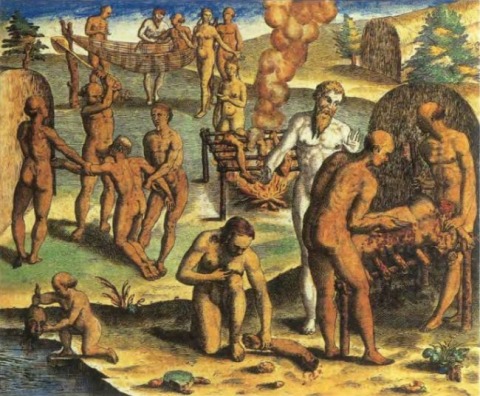
Now as to people-eaters. Cannibals, as well as others who collectively shed blood (including people in our own part of the world), often perform rituals which seem to be about expiating guilt, for example ritual purification and seclusion. Examples of tribes who do this include the Wari and the Tupinamba of the Amazonian basin, and the Maori of New Zealand. In the talk of mine to which you listened, I remarked that such rituals are often performed prior to going on raids, but actually they seem to be more prominent afterwards -- as I suppose one would expect.
It’s important to realize that when human beings are driven to do away with guilt, they are not necessarily consciously thinking “I have guilt, and I have to get rid of it.” In fact, they may give all sorts of other explanations of their motives. Although anthropologists sometimes distinguish between guilt cultures and shame cultures, the phenomena associated with guilt seem to be universal; they are present in so-called shame cultures too, even if disguised by the fact that the members of such cultures do not have adequate ways of talking about guilt. The hypothesis of suppressed guilty knowledge seems to explain what they are doing better than alternative hypotheses do.
In some cannibal tribes the killer himself is barred from feasting on the flesh of his victim; his flesh is reserved for the other members of the tribe. But if what he did was good and right, as the tribe claims that it was, then why shouldn’t the tribe instead honor him by letting him eat first? Again, when those who shed blood use smoke, washings, and other means to purify themselves, of what are they trying to be cleansed? Whatever answers to the question they may give themselves, the hypothesis which best accounts for such practices seems to be that they are trying to purge themselves of guilt. Yet again, tribal warriors who shed blood sometimes slash and scarify themselves – like many people in our own culture too -- and various tribes may offer various explanations of why they do this. But when someone deliberately hurts himself, and is not just trying to show how tough he is, it is hard to view his act as anything other than self-punishment.
By the way, in my own country obsessive self-cutting seems to be on the rise among teens. Although American teens aren’t cannibals, this too seems to be largely about self-punishment.
Sometimes, the explanations of the tribes themselves come close to what I think is really going on. For example, they may speak of the need to make some sort of “repayment” or to restore some sort of “balance.” But doesn’t repayment imply a moral debt, and doesn’t restoration of balance imply a moral imbalance?
Now as to other things you might read. In reasoning the way I have above, I have been using what philosophers and logicians call “argument to the best explanation.” For a more detailed explanation of how argument to the best explanation can be applied to apparent cases of moral denial, and how I reply to objections, take a look at my article, “The Same As to Knowledge.” Though I mention cannibals in that article too, most of my examples have to do with abortion, which I have studied much more closely. For another short article (an older one which is the ancestor of the one just mentioned), you might take a look at “The Revenge of Conscience.”
Yes, as you guessed, I do address these topics in my books. You might look at two of them in particular. One is What We Can’t Not Know: A Guide, which is a sort of plain person’s guide to moral common sense. Several of its chapters give attention to moral self-deception. For a study of Thomas’s Aquinas’s theory of natural law, check out my Commentary on Thomas Aquinas’s Treatise on Law. My free online Companion to the Commentary includes additional thematic discussions of various fundamental issues in the Treatise.
Besides Thomas Aquinas, you also mention Augustine of Hippo. Good thought: He is very interesting on these topics. It just so happens that I’ve recently written a long article about natural law in the Fathers of the Church, both Eastern and Western, for a conference which took place in October. Augustine is included, along with lots of other writers, like John Chrysostom and Maximus the Confessor. Later on, I’ll be posting the article on my Articles Page, and I’ll also be posting the much shorter talk based on it at my blog.
All sorts of other things I’ve written about natural law, some for scholars and some for ordinary folk, are archived at this website too. I’ve just mentioned the Articles Page, and you can also consult the Books Page. In the more scholarly items, I include lots of footnotes, so you’ll easily be able to track down the works of a number of other writers on the topic, though most of those I mention are older ones.
Oh, by the way: You mention your melancholic temperament. Although I am almost always cheerful these days, constitutionally I can identify with that. I think you may find this blog post on the topic helpful: “God Rest Ye Merry, Melancholics.” It was written for the penitential season of Advent, but it applies at all times.
Thanks for writing. Happy, non-melancholic reading!