The Underground Thomist
Blog
Two Little Announcements about HappinessThursday, 02-10-2022
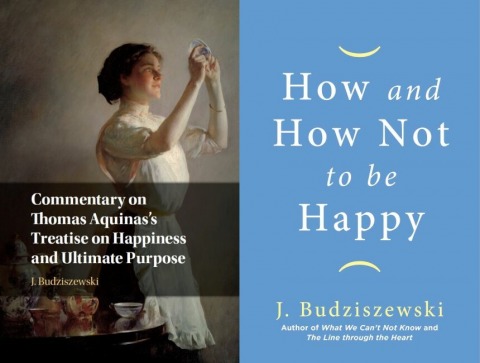
People are always asking me when my Thomas Aquinas commentaries will be released in paperback editions because the hardcover editions are so expensive. The law commentary and the virtue commentary are already in paperback, and I’m pleased to announce that Cambridge University Press has just released the paperback edition of Commentary on Thomas Aquinas's Treatise on Happiness and Ultimate Purpose too. Better yet, until February 28, there is a 20% discount, knocking the paperback price from $39.99 to $31.99. To get the discount, go to www.cambridge.org/9781108745406 and enter the code CTATHUP22 at checkout. That’s good timing, because my new book from Regnery, How and How Not to Be Happy, will be released in hardcover on March 1. Although I always try to make all my books accessible to everyone, The Commentary on Thomas Aquinas’s Treatise on Happiness and Ultimate Purpose is primarily for students and scholars, but How and How Not to Be Happy is aimed squarely at general readers. More about the latter book in a few weeks! Cambridge says about the Commentary, “This monumental, line-by-line commentary makes Thomas Aquinas’s classic Treatise on Happiness and Ultimate Purpose accessible to all readers. Budziszewski illuminates arguments that even specialists find challenging …. This book’s luminous prose makes Aquinas’s treatise transparent, bringing to light profound underlying issues concerning knowledge, meaning, human psychology, and even the nature of reality.” The main sections are I. Man's Ultimate Purpose (Question 1); II. Happiness Itself; A. Where Does Complete Happiness Lie? Failed Candidates (Question 2); B. What Then Is Complete Happiness in Itself, and In What Does It Really Lie? (Question 3); C. Its Attainment; 1. What Complete Happiness Requires (Question 4); 2. How Complete Happiness Is Finally Attained (Question 5). “Budziszewski's Commentary on Thomas Aquinas's Treatise on Happiness and Ultimate Purpose provides an in-depth, detailed, accessible, and comprehensive commentary on the Summa theologiae's questions on happiness. This commentary is a gem. It can be read with profit by philosophers, theologians, and intellectual historians, as well as by their students. If you are interested in Aquinas, want insight about happiness, or both, this book is for you.” -- Christopher Kaczor, author of The Gospel of Happiness and Thomas Aquinas on the Cardinal Virtues.
|
A Little SecretMonday, 02-07-2022
Here is a little secret that you can get cancelled for telling: So called sex change doesn’t change sex. Among other things, the brain is already indelibly stamped male or female. Injecting hormones does not erase the stamp, and amputation of the genitals or breasts does not affect the brain at all. We might as well say that if I have my vocal cords severed, my limbs surgically altered for running on all fours, and my skin stimulated to grow a pelt, I will be a fox. No, I will be only a mutilated man. For details you can see the notes at the end of this post, but brain physiologists tell us that large parts of the brain cortex are thicker in women than in men. Ratios of gray to white matter vary, too. The hippocampus, which plays a role in memory and spatial navigation, takes up a greater proportion of the female brain than of the male brain. On the other hand, a certain region of the hippocampus is larger in the male. A variety of neurotransmitter systems work differently in men and women. The right and left hemispheres are more interconnected in female brains than in male ones, and the corpus callosum, which links them together, is larger. The amygdala, involved in emotion and emotional memory, is larger in men, but the deep limbic system, which is also involved in emotion, is larger in women. Sex-related differences between the hemispheres exist for other brain regions as well, including the prefrontal cortex, involved in personality, cognition, and other executive functions, and the hypothalamus, which links the nervous system with the endocrine system and has some connection with maternal behavior. External circumstances, such as chronic stress, act on male brains differently than on female. Brain diseases diverge in men and women, not only in frequency, but in age of onset, duration, and the way they manifest themselves. Even the neurological aspects of addiction differ between the two sexes. Is carving people up and pumping them full of chemicals going to change all that? By the way, although we should always be compassionate, compassion does not lie in encouraging souls who suffer delusions about their sex to sink even deeper into delusion, and to dope and mutilate their bodies. The evidence does not even support the claim that persons who have had so-called sex change surgery are happier after the damage is done. Thinking that happiness is getting what one wants, they often believe that they will be happier, but by and large all their former psychological problems persist. One of the best and largest studies, carried out in Sweden, found that “Persons with transsexualism, after sex reassignment, have considerably higher risks for mortality, suicidal behavior, and psychiatric morbidity than the general population.” A man who eventually had his sex change surgery reversed writes poignantly, “Nothing made sense. Why hadn’t the recommended hormones and surgery worked? Why was I still distressed about my gender identity? Why wasn’t I happy being Laura? Why did I have strong desires to be Walt again?” May I make a modest suggestion? Let’s stop calling it “kindness” to tell lies to unhappy people. It may make us feel good, but it shouldn’t. NotesDoreen Kimura, “Sex Differences in the Brain”Larry Cahill, “His Brain, Her Brain”Larry Cahill, “Why Sex Matters for Neuroscience”Related:On the Meaning of Sex
|
A Vaccine for BitternessMonday, 01-31-2022
There is another pandemic, far worse than the coronavirus, a plague of cultural insanity. At present I am not trying to argue the point, but speaking to the multitude who already know. The superspreaders of the plague don’t see themselves as crazy, and they have a lot of power to do harm. Needless to say, contagious madness has to be resisted and argued against. But there is so much sickening venom in public discourse! How can anyone swim against the flood of bitter poisons without swallowing some of it and becoming sick himself? It is easy to rant against ranters, to be bitter against the bitter, and to go mad in opposing insanity. But that doesn’t help a bit. Allow me to announce the vaccine for contagious madness: Humor. And I am not joking. Though it wasn’t a sidesplitter, I hope the last sentence gave you at least a very small smile, because the superspreaders of the plague are utterly humorless about themselves. St. Thomas More’s remark that “the devil … cannot endure to be mocked” is familiar, but the passage in which it appears is not so well known, and is well worth quoting too. This is from More’s Dialogue of Comfort against Tribulation, written while he was in prison for conscience -- a circumstance in which the reason of a less virtuous man would have tottered. Though the temptation to bile and bitterness must have been very great, More makes a strength of it: Some folk have been clearly rid of [certain] pestilent fancies with very full contempt of them, making a cross upon their hearts and bidding the devil avaunt. And sometimes they laugh him to scorn too …. And when the devil has seen that they have set so little by him, after certain essays, made in such times as he thought most fitting, he has given that temptation quite over. And this he does not only because the proud spirit cannot endure to be mocked, but also lest, with much tempting the man to the sin to which he could not in conclusion bring him, he should much increase his merit. The great saint is not speaking of the sort of thing that passes for humor among most of today’s comics and funny men. The wrong kind of mocker laughs goodness and innocence to scorn, and he cannot bear to be mocked any more than the devil can. But the right kind of mocker is a cheerful friend of archangels, who destroys wicked pretense by showing how silly it is, and does not mind being mocked by silly people. May we all become humbler scoffers, godlier mockers, and more fruitful fools.
|
For No Other Reason?Monday, 01-24-2022
An Op-Ed piece in the Los Angeles Times begins with the dismal words, “At the start of this new semester, we face a sobering reality. As law and political science professors, we’re in new territory: instructing our students about the foundations of constitutional law when neither they nor we have faith that the current Supreme Court will respect precedent and approach the law as the institution once had.” It speaks volumes about near-monoculture of contemporary academia that the authors can simply take for granted that all students and all professors of law and political science share both their dismay at the direction of the Court and the leftist ideology that produces that dismay. Leading their litany of lamentations is that “Students see a court about to overrule or gut Roe vs. Wade, a half-century-old precedent, for no reason other than that the conservatives have the votes to do so.” “For no other reason”? If the former remark spoke volumes, this one speaks libraries. Apparently the authors no longer even consider themselves bound to acknowledge that social, moral, and judicial conservatives have any arguments at all for what they do. Try the following reasons. One might argue against them. No doubt the authors would. But pretending that they don’t exist is nothing but hubris. ● No right to abortion is mentioned in the U.S. Constitution, nor does any such right follow logically from those that are. This right is supposedly based on a privacy right, which is treated as an autonomy right, which is treated as an I-get-to-do-what-I-want right, which also isn’t in the Constitution. ● Roe’s argument purporting to discover such a right in the Constitution was so badly reasoned that even many pro-abortion scholars decline to defend it. ● Moreover, the opinion in Roe was based on a demonstrably false judicial history. There was not a traditionally recognized right to abortion. ● Decreeing that we may not overturn any long-established precedent, no matter how specious and unjust, reduces jurisprudence to a farce. Among other things, it would have forbidden overturning the precedent that declared slaves to be chattel. By the way, Roe reversed the preexisting pattern of not recognizing any so-called abortion right, and overturned the laws of all fifty states. ● The unborn child is not a “potential” human life but a real one. From the moment of conception, he or she is both fully alive and fully human. We may concede that the baby is not fully developed; neither is a five-year-old. ● Nor is the child merely a part of the mother’s body. Though inside her body, this little being is a distinct individual with unique DNA. Mother and child may even be of different sex and have incompatible blood types. ● So-called “viability” is not a measure of human worth, but merely a shifting index of our medical abilities to date. In the broad sense, not even born infants can survive outside the womb without continuous care. ● Abortion cannot be a “reproductive right,” because it has nothing to do with enabling people to reproduce. It is not even merely an anti-reproductive right, because rather than just snuffing out fertility, it extinguishes a life. ● Nor can abortion be a “woman’s right.” The purpose of human rights is to protect human goods. The very suggestion that it could be good for mothers to set them against their own offspring is an insult to women and a setback to the cause of their dignity. ● The raison d'être of law is the common good. Authorizing the private use of lethal violence against the weakest and most vulnerable does not advance the common good, but despoils and overturns it. ● All rights presuppose the right to innocent life. If innocent human beings lack even the right to live, then there are no human rights at all. ● Finally, abortion is murder. No doubt the interpretation of the fine points and remote implications of the natural moral law should be left to legislatures. But permitting the slaughter of innocents offends the most basic principles of justice, apart from which the edicts of rulers have no claim to authority whatsoever. These reasons might have been sufficient, if only they had existed.
|
Free Exercise of What?Saturday, 01-22-2022
Judges and lawyers tend to think that some systems of absolute commitment and belief are religions and others aren’t. Anthropologists would laugh at this idea. In the broad sense, they all are. The important thing is what kind they are. Once we see this, we realize that religion in the sense of the Constitution – religion the Free Exercise of which is protected by the First Amendment -- can’t possibly refer to religions in that broad sense. Why not? Because in the original meaning of the term, exercising a religion means more than believing in certain things; it also means doing certain things and living in a certain way. To think that the Framers would have wanted to protect the “exercise” of, say, an assassination cult, is absurd. The courts are afraid to grasp this nettle. Bizarrely, they try to construe the meaning of the clause concerning the free exercise of religion without settling the meaning of the words in it – especially that prickly word “religion.” Their favorite sidestep is to say that law must be “neutral” about religion -- as though one could determine what it means to be neutral about it without knowing what it is. There is no such thing as neutrality. No way of dealing with religion is neutral toward religion; every way of dealing with it is some way of dealing with it. Besides, the Framers plainly didn’t intend neutrality between religion and irreligion anyway. They guaranteed the free exercise of religion as a protection for religion, and they wanted to protect religion because they thought it was good. The Supreme Court concedes this fact even in the act of denying it. In the 1963 case Abington v. Schempp, it oxymoronically remarks that one of the reasons for neutrality lies in the Free Exercise Clause, “which recognizes the value of religious training, teaching and observance.” Though it seems almost too obvious to point out, to assert the value of religion is not to endorse neutrality between religion and irreligion, but to say that religion is better. But the Framers must have intended the word “religion” to mean something, or the Free Exercise Clause is empty. So what did they mean by it? To put it another way, how can we pin down, without being arbitrary, the sense in which the clause uses the term “religion”? How can we determine which kinds of religion are the kinds to which the Clause refers? Although most of the Framers were Christians, I think they were using the term “religion” in a broader sense than Christianity – though not infinitely broad. They were referring to those truths about God that can be ascertained by reason, even if one does not have the additional data of revelation. And if we look at the way they actually wrote, then I think we can easily find out they thought these truths were. Consider just the Declaration of Independence. It speaks of “the laws of nature and nature’s God.” It says that the “Creator” has endowed us with certain liberties. And it appeals to “the Supreme Judge of the world,” expressing “firm reliance on the protection of divine Providence.” These were not empty pieties. I think it is reasonable to conclude that by religion, the Founders meant something like providential moralistic monotheism with a high view of the human person. To explain: By the word providential I mean they believed that God is paying attention. Ministers invited to address colonial legislatures taught that God would protect the country’s cause against the injustice of England, but only so long as the country itself behaved justly. Even the Deist, Thomas Jefferson, confessed that he “trembled” to consider how God’s justice would deal with the country in view of the injustice of slavery. Abraham Lincoln viewed the Declaration’s statements about equality as a promissory note, a public commitment implying a duty to eliminate that evil as quickly as possible. By the word moralistic I mean they believed that by having created nature, God is also the author of the natural moral law. It would seem to follow that freely exercising religion – by contrast with freely exercising sham religion and idolatry -- could not include acting in violation of this law. Writers of the time all conceded that the basic precepts of this law were well summarized by the Ten Commandments. By the word monotheistic I mean they believed that there is one God, and only one God, and that this God is not Me, or Us, or the All, but the Creator of myself, of us, and of the All. Were there more than one God, there might have been multiple, competing creations, or multiple, competing moral laws. Presumably, then, narcissists, polytheists, pantheists, and atheists might enjoy lots of liberties -- free speech and assembly and so on -- but would not enjoy whatever additional protection the Framers had in mind for religion. By saying they held a high view of the human person I mean they believed that having made us in His image, the Creator not only laid duties upon us, but gave us rights – and a good thing, because without the liberty to do our duty, how could we do it at all? These are not rights against God – they are rights against each other. You may not make me your tool. You may not deprive me of innocent life, or of the requirements for living humanely. Nor may you prevent me from serving God Himself. Whether or not we approve of this approach to religious liberty, I think it is probably what the Framers had in mind. It does not officially establish any particular religious sect in the sense of giving special legal status to it – but it is anything but religiously neutral. For it privileges all those sects that are providential, moralistic, and monotheistic with a high view of the human person – and it disprivileges, even though tolerating, the rest.
|
Novelists as PimpsMonday, 01-10-2022
In hell, Francesca da Rimini tells Dante of the moment of her downfall. She and her brother-in-law Paolo, who were already attracted to each other, were enjoying what used to be called “the near approach of sin” by reading to each other a romance about the adultery of Lancelot and Guinevere. Upon reaching a certain passage, they went up in flames. In hell, she mourns, “A pander was that author, and his book!” It’s interesting to see how difficult some writers and reviewers find it to admit the nature of the sin. For example, one online discussion page says Francesca and Paolo were “innocently” reading the book together. I’m surprised that Canto 4 hasn’t yet been purged from our copies of Dante’s Inferno. Censorious editors sometimes used to expurgate passages in books that were morally objectionable; it was called bowdlerizing. Now they expurgate or change passages that aren’t objectionable enough. In one conspicuous example, Hollywood changed the ending of Hawthorne’s Scarlet Letter so that the adulterers enjoy a happy ending. Francesca was making excuses for herself, but she was also onto something. Recently an Op-Ed columnist whom I occasionally read in the Wall Street Journal took time off from political commentary to praise the depiction of James Bond, the ultimate objectifier of women, because he is always a “gentleman.” I suppose this was because the fine fellow dressed so well and drank his gin so elegantly before bedding the women he called by filthy names, or perhaps because Miss Galore stops resisting after he throws her down and forces himself on her. A few years ago, a book reviewer in the same formerly-staid publication unabashedly praised another work of speculative fiction for having lots of good sex. What struck me wasn’t simply that prurient matter which would once have been condemned is now treated as delightful. In our age, one expects that. No, the surprising thing was that the reviewer presented authorial laziness and crudity as marks of literary skill. Silly me, I thought laziness and crudity marked lack of skill. Talented writers depend on plot and character to hold the attention of their readers, not on sheer sexual arousal. Of course real people, and by extension fictional people, do at times get into bed together! But if the fact that the characters are sexually involved is necessary to the story, even so the physiological and anatomical details may be left offstage, thank you. One formula that sells a lot of books is to present the male lead as having a history of indiscriminate and almost anonymous sex, and yet capable of caring for the female lead so deeply that he would die for her after their one-night stand. “Even after having all those others, I am the one he chose.” The former specification pleases randy male readers, who put themselves in his place. The latter pleases female readers, who even in these crass times want their men to be romantic. No doubt the formula was generated by some marketing algorithm; profit excuses everything. The authors may also be trying to rationalize things about themselves that they might not wish to disclose. Or perhaps they are flattering readers of both sexes who have their own excuses to make. “What’s wrong with that?” I spoke with one author who defended her practice on grounds that if she didn’t put a lot of gratuitous sex into her novels, publishers wouldn’t buy them. What’s wrong with it is that stories written to such formulae are vicious lies. In real life, the two blended character traits are incompatible. The pretense of their compatibility warps the presentation of reality no less, and no less culpably, than the drug dealer who promises ecstasy from chemical enslavement. And the authors know what they are doing. The word “pornography” comes from the combination of the Greek words pornos and graphos, meaning the writing of prostitutes. A better word for much of the novelistic trade today would be "pandography": The writing of panders and pimps.
|
Covid and Civil DisobedienceMonday, 01-03-2022
I received this letter at the beginning of autumn, when the Covid regulatory regime was somewhat stricter. We have had vaccines for some time, the Omicron variant seems much milder, and recovery from it seems to provide some protection against more serious strains. Nevertheless, restrictions are tightening again, so the exchange may still be of interest.
Query:I work at a Catholic diocesan school in a state in which masks must be worn in all schools (including parochial ones). My school is complying and we enforce it as a rule for students. Now, these students have not been wearing masks all summer. They do not wear them during lunch or when outside. I doubt more than a few if any wear them outside of school, where they are not required. Given this, it seems absurd that the masks would have any overall effect on public health. Does that imply that this law is out of accord with reason? Further, is there a greater good in obeying this law because it will allow the school to remain open to provide academic and Catholic education with less difficulty than if the bishop decided to oppose this law? I've told some of my students that we must be willing to suffer for what is good and true, even if we suffer the relatively minor impairment and discomfort of face masks for the sake of school. Yet I can't help but wonder if the better course would be to suffer the fines and legal prosecution rather than accept and promote such an absurd rule. If you have a suggestion on how to resolve this, I'd love to hear it.
Reply:Public authorities have lost so much credibility that mandates are becoming unenforceable, so your problem may not last long. Then again it might, so let’s work through the issues. Surely you’re right that the student masking rule is unlikely to have any effect on the spread of the virus. Moreover, some people have health conditions, such as asthma, which make wearing masks inadvisable. Although some areas with mask mandates allow exemptions for health reasons, others don’t. I suggest that overzealous regulators are motivated not so much by public health as by less creditable desires, such as giving themselves cover when nervous people say they aren’t doing enough. To explain: There are two degrees of severity in unjust laws. Those which are unjust because obeying them would require formal cooperation in moral evil must be disobeyed; for instance, one would have to disobey a command to commit murder. Those which do not require formal cooperation in moral evil yet are nevertheless unjust because (1) they serve private interests rather than the common good, (2) they are made without proper authority, or (3) they violate the formal norms of justice, may be disobeyed – except perhaps when the harm caused by disobedience is even greater. The two kinds of harm which disobedience might cause are scandal, which means acting in such a way as to discredit good behavior (even if unintentionally), and disturbance, which can mean anything from causing riots to causing confusion. So in principle, unjust laws are not true laws at all, but frauds, imposters, phony laws – things that are called laws, but aren’t. However, it doesn’t necessarily follow that I may disobey. One kind of phony law must always be disobeyed; about another kind, one must exercise judgment. Your case, as I think you recognize, would be a type two phony law. I can’t substitute my judgment for yours -- but since you ask, I would say that in your case the burden of wearing the mask is exceeded by the risk of scandal. In fact, the risk of scandal is twofold. One part of the scandal has to do with your teenage students, since teens are not known for discernment, and you don’t want to give them the impression that laws in general do not have to be obeyed. The other part of the scandal -- I think the greater one -- is that the school and the Church might be discredited in the eyes of the public and so become vulnerable to official retaliation. You can imagine how this would go. Those religious nuts won’t obey the law! They don’t care about the spread of disease! Let’s shut down their schools once and for all! It’s also a good idea to remember that even though public policy concerning Covid seems to have been motivated more by panic, desire to look good, and sheer enjoyment in making people do things, than from a genuine and well-grounded concern with public health – still, there is a difference between finding a law unreasonable, and considering it so crazy that no reasonable person could deem it reasonable. For this reason, we should probably require the irrationality of a law to meet some threshold of obvious insanity before we consider disobedience. The more extreme Covid-era restrictions do present occasions for valid civil disobedience – lots of them. For example, if the State tells the Church that she can’t celebrate Mass or hear confessions, the Church should patiently explain the injustice of the commands, but then tell the State “You are free to arrest us if you wish, but we must obey God rather than man.” I wish more of our bishops had been brave enough to act like this -- some were! In my opinion, however, just having to wear a mask in the classroom doesn’t rise to that level. By the way, the risk of scandal is not necessarily fixed. If some teachers in one school disobey the law without explaining their reasons, the scandal is probably great, because they will seem like mere hooligans. If all teachers in all schools disobey the law and fully present their reasons, the risk of scandal may be lessened. That’s the approach Martin Luther King took to the risk of scandal. Rather than saying “If disobedience would gravely risk scandal, then don’t disobey,” he said “See if you can figure out a way to disobey that won’t so gravely risk scandal.” Thus, his protesters announced what they would be doing, did it peacefully, explained why they were doing it, and accepted the legal punishment, showing that they recognized the necessity of law which is truly just. In the case you describe, though, reducing the risk of scandal would be an uphill battle. Why? Because everyone knows that the Church does not possess any special medical expertise. Not only that, the press will inevitably misrepresent her actions. There is such a thing as unavoidable scandal, but this isn’t it. We don’t want her to lose credibility as a teacher of morals and doctrine, which she is qualified to teach, because she is going out on a limb regarding epidemiology, which she is not qualified to teach. All this is terribly distressing. So many of my own students have been misinformed, believe everything they hear from biased sources, and are terrified of dying. I even see them wearing masks outside on windy days when no one is anywhere nearby. As for myself, I am one of those who find it difficult to breath while wearing them, and I detest the mandates. For a teacher like you, there is an upside. In fact, there are two of them. First, the situation presents you with a grand opportunity to discuss civil disobedience with your students. Most don’t know that it was the Angelic Doctor, Thomas Aquinas, who developed the first systematic account of when unjust laws may be disobeyed – the one I’ve been following in this letter. Second, the occasion gives you a wonderful opening to discuss what is really important in life. Health is good, but is it the greatest good? If people really thought that any human cost whatsoever is worth bearing to prevent any risk of a single death – as some do claim to believe -- then they would be calling for the evacuation of all towns and cities, and for the abolition of trains, planes, boats, and automobiles. There are worse things than catching a virus, and saying so doesn’t mean that you want everyone to die. Related:Civil DisobedienceResisting Tyrannical GovernmentsBetween Man and Man: Friendship, Law and the Common Good
|