Query:
I’m not sure where you get your questions, but I wanted to submit one for consideration. Here’s my question:
I feel like it's unfair that one man sinned, and now all people are born under judgment. It seems like God is holding us accountable for something we had no control over. I've heard the argument that if I were in the Garden of Eden, I would have sinned too (and so would everyone else). Perhaps true, but that raises a different issue.
If I bought a product and it broke, I'd return it for another one. If the next one broke the same way, and then the next one, I'd assume the problem is not a bad individual product, but a bad design.
Why didn't God make humans smarter/wiser/whatever so that they would choose not to sin? Free will is a complicated topic, but if obeying God is a dramatically better choice, why didn't God make us capable of recognizing that?
Thanks for any insight you can provide. I used to read your column on Boundless a long time ago, btw.
Reply:
Thanks for writing. You say “Here’s my question,” but I think it’s actually two questions:
(1) Why didn't God make humans wiser so that they would choose not to sin? Why didn’t He make us capable of recognizing that obeying Him is a dramatically better choice?
(2) How can it be fair that though only one man sinned, now all people are born under judgment? Is God holding us accountable for something over which we had no control?
As to the first question: God did make humans capable of recognizing that obeying him is a dramatically better choice. The whole point of it being a choice, however, is that we are not compelled to do it. You may be assuming that whenever we can see what is good, we will do it. Plato thought so; he reasoned no one does evil except through ignorance. But this is contrary to all of our experience, because we are quite capable of doing evil even with our eyes open. Haven’t you ever done something stupid, knowing that it was stupid? I have.
It’s true that we can’t do evil for the sake of evil, but we are all too capable of pretending to ourselves that what is evil is actually good. In fact, we even fabricate excuses for wrongdoing from the moral law itself. For example, I might justify stealing from another fellow by telling myself that it’s unjust for him to have more than I have. My pretense is that taking it is really an act of corrective justice. The only way to make it impossible for us to make evil choices would be to deprive us of free will, so that they weren’t really choices at all.
Well, why not do that? What’s the big deal about free will?
The big deal is that if we do what we do only because we are compelled to do it, then our actions lose most of their meaning and all of their moral value. Consider: If I freely perform some sacrificial good for my wife because I love her, then she is honored by my sacrifice and knows that she is cherished. But if I do the same thing for her just because she paid the neighborhood magician to give me a love potion, then I haven’t really cherished her or done her honor, but merely acted under the spell. Love isn’t love unless it isn’t freely chosen. Since a world without freedom would be a world without love, it wouldn’t be a better world, but worse.
Your second question concerns what is called “original sin.” I think this one is the harder of the two, and will take longer to answer. Christians have been discussing it for centuries.
Here’s my take on it. Stay with me, because the matter is complicated, but that’s just how it is. It would be silly for physicists to complain, “The truth about quantum mechanics is too hard!” In the same way, it would be silly for us to complain that the truth about God is too hard. The truth about God is just exactly as hard as it has to be in order to fit how things really are with Him.
“Actual” sin and “original” sin are both sin, but not in precisely the same sense. Rather they are analogous to each other. What we call “actual” sin is easy to understand. For example, suppose I commit the sin of envy against my neighbor. Several things result. One is that I weaken my mind’s control over my emotions. Another is that I become disobedient to God. A third is that I incur guilt for having done so, because I did it freely. Not to mention the fact that in my envy, I may hurt him.
“Original” sin is the tough one. Let me offer a comparison. A high-performance fighter jet has an excellent design, but the freedom of the aircraft to turn this way or that way, as the pilot chooses, depends on a degree of instability. This isn’t something wrong with the design, but something right with it. As engineers say, “It isn’t a flaw, but a feature.” After all, if the fighter jet were utterly stable, it would keep going the same way no matter what the pilot did. Thus, it isn’t enough for the pilot to have a well-designed aircraft. He also needs skill so that he can steer and respond to changing conditions -- and he needs to keep his eyes open, facing in direction of flight.
Now our nature is something like the design of the high-performance fighter jet. We have all sorts of powerful engines and control surfaces -- abilities, desires, and emotions which can be turned this way or that. For example, I might allow my anger to arouse me to defend my children from attack by someone who tried to hurt them, and that would be good. But on the other hand I might let it push me into smashing the nose of someone who offered a justified criticism, and that would be bad. So here too, there is a degree of instability, but here too, it isn’t something wrong with the design – in this case the design of human nature -- but something right with it. It’s a precondition of our freedom. Not only that, but just as the pilot, in order to fly the jet, needs to have skill and keep his eyes pointed in the direction of flight, so we, in order to “fly” our nature, need to have virtue and keep our eyes pointed in our direction of flight, which is toward God.
But here’s the catch. The pilot doesn’t need help to keep his eyes open and facing in the right direction. We do need help to keep our spiritual “eyes” open and facing in the right direction. Hy? Because God isn’t just something in the created world, something visible to the senses, like a landmark the pilot can look at – God is the Creator of the world, Himself uncreated, invisible to the senses. Our natural power is not equal to looking toward the supernatural God; to keep facing Him, He must give us a certain special grace which lifts us above ourselves.
Our first parents were born with that gift, which is called “sanctifying” grace. But just as the pilot might refuse to fly right and end up damaging his aircraft, so our first parents refused to “fly” right and ended up damaging their nature. They lost what is called the “original integrity” of their nature. I suppose we could say that they suffered “original damage,” but theologians use the term “original sin.” Why sin? Because in refusing to fly right, they did wrong.
But that’s about them, not us, right? No, it’s about us too. Just as our “actual” sin does several bad things to us, so “original” sin does several bad things to us -- not in precisely the same way, but in an analogous way.
Think about it. Does what our first parents did still hurt us inwardly? Yes. The damage they did to themselves affected all future generations. Our nature was designed so that our minds would control our emotions and desires. That ability hasn’t been lost to us later human beings, but it has been weakened. Sometimes it seems as though we had become combustible – as though our emotions and desires had become kindling wood for sin – because at the least little spark, we burst into flames. “That isn’t fair!” we say. Well, in a sense, no, just as it isn’t fair that a child is born in a state of addiction because his mother used addictive drugs while he was in the womb. But would you want a world in which nothing had consequences, nothing had meaning? A world in which children turned out the same no matter how their parents raised them? In that case, why bother with parents at all? God bothers with parents because He chose to make a world in which finite rational creatures are given the astounding privilege of imitating His Fatherhood and participating in the wisdom by which He governs the universe. By the fact of raising my children, for good or ill I am also helping raise my children’s children’s children, so the privilege is not taken away, but intensified! But with this privilege comes responsibility, for failure to live up to it causes real hurt to others. The flip side of the power to do good is the power to do harm. (You might read this blog post too.) So it is with what our first parents did.
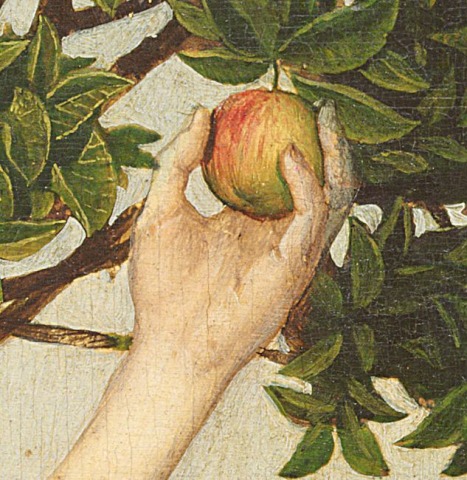
Do we have personal responsibility for what they did? In a sense no, but in a sense, yes. Certainly I am not responsible for the sin of my first parents in the same sense that I would be if I myself had eaten of the forbidden fruit. Nevertheless, I share in the shame of they did. “That isn’t fair either!” Sure it is. They were the representatives of the whole human family, me included. Suppose your mother and father and aunts and uncles had committed terrible atrocities before you were born. As a member of the family, wouldn’t you be ashamed of their deeds? Of course you would. “But I didn’t do those things, they did!” But no one really thinks like that. We all realize that a family has a certain joint responsibility for its members. And this too is passed on through the generations. We’re individuals – but we’re not just individuals. We’re connected.
So is God beating us up for what was done in the Garden as though we ourselves had done it? Certainly not. Nevertheless, what was done in the Garden has consequences. Because of it, things are much harder now. Yes, there is still in each of us a longing for God. Yes, we are still made in His image. But we are no longer born with our eyes already turned in His direction; in fact, we’re born spiritually cross-eyed. And our fearfully and wonderfully made nature is now in a bad condition.
Yet the loving God had compassion upon us, and took the worst of our shame and suffering upon Himself, so that we, beyond all deserving, could be restored to Him. That is the meaning of the Cross.
I hope you keep asking good questions. By the way, you mention my old Office Hours and Ask Theophilus columns from the old Boundless webzine. A lot of them are still posted here on my Theophilus Unbound page!
NEW STUFF
“Made in the Image of Nothing”: My review of Carl Trueman’s excellent new book, The Desecration of Man.
The text of a short interview with me, with a link to the audio, about Pandemic of Lunacy, on World magazine’s podcast, “The World and Everything In It.” The interview begins at 23:20.