The Underground Thomist
Blog
Reading and WritingMonday, 11-30-2015
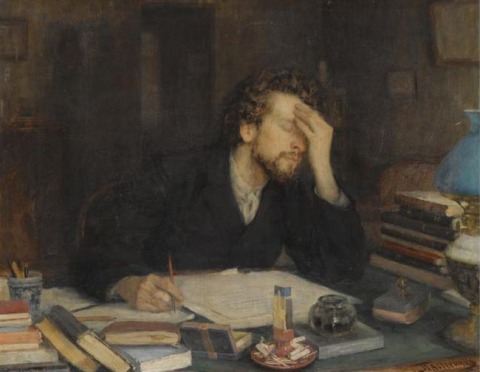
I try to reserve Mondays for student letters. This student writes from Belgium.Question:I have two rather general and methodological questions: First, even though I’m entering a Master’s level program, I actually haven't had much experience writing essays. I’ve read some "How To" books on the subject, but I still feel a bit confused. How do I prepare to write the essay? How do I structure it? What makes an essay a good one? Second, even though I have a good grasp of history of philosophy, I feel like missing some essential tools for reading philosophical texts. As if I was lacking the capacity to ask the deeper questions in order to understand the hidden nuances. As if there was always a sort of underlying context or dynamics I don't see. Would you have any suggestions in this regard? Reply:Have you read A.G. Sertillanges, The Intellectual Life? It is a wonderful book, and I’ll bet it’s a lot different than the “How To” books you’ve been reading. If you haven’t read it already, I would recommend dropping everything and reading it right away. But now let me turn to your questions. As to your question about writing, I think the biggest mistake most students make is to think that their task is to “research” an interesting “subject.” An unlimited number of things can be said about most subjects, so if you take this approach you will never be able to know when you are finished. Your task isn’t to “discuss” a subject. It’s to do something about the subject, something that adds to our knowledge. Usually, that means framing and answering a question about it. Sometimes it might mean framing and solving a puzzle about it. It may also mean trying to demonstrate a claim about it which you have good reason to think may be true, or trying to refute a claim about it which you have good reason to think may be mistaken. Framing the question provides your preparation; answering it provides your structure; and a good essay is one that answers it well and truly. At least half of your work will usually lie in framing it. Unless you discover in the middle of composing the essay that you’ve framed it badly, that half will take place before you even set pen to paper. But suppose you do discover midway that you’ve framed it badly; it is confusing you and leading you down blind alleys. Don’t despair. Just go back and re-frame the question, and this time get it right. After all, if you’ve misframed your question, isn’t it better to find that out than to fail to find it out? Besides, discovering that some important question has been misleadingly framed is one of the main ways that philosophy advances. Now for your question about reading. The first thing to realize is that the thinkers whom you will be studying were doing the same thing that I’ve just been telling you to do. In other words, they weren’t trying to “research” a “subject,” but to frame and answer important questions about it. So before all else, try to discern what questions a writer is asking, how he frames them, and why he frames them just that way. Then, before asking what you call the deeper questions, try to understand your own deeper assumptions. Unfortunately, we often make assumptions we don’t realize we are making, then read as though the author is making them too (even if he isn’). Ever since Descartes, for example, many philosophers have proceeded as though we must doubt everything, and test the instrument of knowing, the mind, before we put it to work to know anything about reality. If you try to read someone like Aristotle or Thomas Aquinas as though they were trying to do the same thing, you will misunderstand what they are up to, because they would have considered this procedure backwards. In their view, one has to know something about the world even in order to test the instrument of knowing! The way to find out the mind’s weaknesses is to compare one’s thoughts to what is. One of the biggest mistakes we can make in reading is to suppose that we already know all the answers. For instance, suppose you take for granted that everything some thinker of an earlier time says about women is in need of “critique from a feminist perspective.” This may prevent you from discovering that he actually provides a critique of the feminist perspective. What a disaster to be so locked up in our little island of time and culture that we can’t think any thoughts except those we have thought before! Of course I am not suggesting that you can’t disagree with a thinker of another place and time. What I do say is that you should let him speak first. Assume that he might know something! Give him a chance to change your mind! If you take that last point seriously, you will try to enter into conversation with the thinker, and I don’t mean just a social chat. Remember what philosophical conversation is for! As G.K. Chesterton said, “Merely having an open mind is nothing. The object of opening the mind as of opening the mouth is to shut it again on something solid.” It doesn’t matter how many centuries ago the thinker you are studying was writing -- reach out with your intelligence. And don’t just ask him questions and try to discern how he would answer -- “What do you mean by that?” “Why do you think that it’s true?” “How would you reply to such and such an objection?” You should also submit humbly to the questions he would ask you, and try to discern what he would think of your answers. As you acquire these habits, you may find that you are reading more and more slowly. That’s perfectly all right, because this sort of reading cannot be hurried. One may even have to creep along line by line, perhaps something like this. Finally, you might find it helpful to outline the arguments of the work you are reading -- not his beliefs, but his reasons for believing his beliefs. Don’t outline while you are reading, though; first read, then outline. In fact, you should probably read the work several times before attempting to outline its arguments. I won’t say any more about analytical outlining here, though, because I discuss it elsewhere. Since man as a rational creature is ordained to seek and know the truth of things, especially in relation to God, we should always be asking ourselves what is really worth knowing, and trying to find it out. Do your work in that spirit.
|
Playfulness as a VirtueSunday, 11-29-2015
Bonus link: Thomistic hilarity “[M]an’s mind would break if its tension were never relaxed. Now such like words or deeds wherein nothing further is sought than the soul's delight, are called playful or humorous. Hence it is necessary at times to make use of them, in order to give rest, as it were, to the soul .... “Now a man who is without mirth, not only is lacking in playful speech, but is also burdensome to others, since he is deaf to the moderate mirth of others. Consequently [such persons] are vicious, and are said to be boorish or rude.” -- Thomas Aquinas, Summa Theologiae, II-II, Q. 168, excerpting from Arts. 2 and 3.
|
The Decline of the StorySaturday, 11-28-2015
How often lately have you begun to read a novel, only to discover that you didn’t like any of the characters and didn’t care two nickels what happened to them? It’s not just that they lack admirable qualities. They even lack interesting faults. Do the authors care about these characters? Why do they think their readers would? But the standards of judgment are also changing. Not long ago I read a book review in one of the great, gray national newspapers which praised the novel in question for -- can you guess? Clue: It wasn't the plot, the characters, or the concept. It sells; it’s easier to write; and it keeps people reading what they wouldn’t read otherwise. If you can call it reading.
|
How Divided Government Was Supposed to Work, and How It Actually DoesFriday, 11-27-2015
The Framers of the U.S. Constitution viewed what we revile as “gridlock” or “stalemate” as a good thing, not a bad one. They assumed that most changes in the law would be bad ones. Consequently, checks and balances among the three branches of government were supposed to slow down decisionmaking and preserve the status quo. The rise of political parties changed all that. In party government, checks among the branches slow things down only when different parties control the legislature and executive. The problem is that on occasions when the Party of the State controls both of these branches, massive ill-advised change can take place very quickly -- and when we do eventually return to divided government, it prevents the repair of all the bad things that were done. Thus although checks and balances were intended to protect the law from damage, in our time they protect the damage.
|
ThanksgivingThursday, 11-26-2015
"For how should he ask for future things, who is not thankful for the past? Wherefore we ought to give thanks for all things, even for those which seem to be grievous, for this is the part of the truly thankful man. In the other case the nature of the things demands it; but this springs from a grateful soul, and one earnestly affected toward God. God acknowledges these prayers, but others He knows not." -- John Chrysostom, Homily 14 on Philippians
|
Why Should We Obey the Natural Law?Wednesday, 11-25-2015
Why should we obey the natural law? Some people say, "Because it is the law of our nature. To aspire to the good is not to conform ourselves to something alien to us, but to fulfill the requirements of our own flourishing." Other people say, "Because it has divine authority. Our nature contains the possibilities of good that it does contain just because it is the creation of God." But the mainstream of the classical natural law tradition has held that these two views are not competitors, but complements, because man is ordained to a twofold final good. The goods available to us by the exercise of our natural powers, such as friendship, family, and knowledge, are good in themselves, yet not enough. Don't we know this by experience? One would think that the better these things are, the more satisfied we would be. Actually, the better they are, the more they stir us up to long for Something More, of which they are only glimpses. Dante knew that. It was the whole point about Beatrice. The glory of this redeemed woman was reflected glory. We cannot finally be satisfied by any love short of divine love, by any vision short of the vision of God Himself. Here is the catch. The supreme good of knowing God is available to us only if we are lifted beyond our natural powers by grace. Our nature is fashioned with the potentiality to receive this gift, but it cannot provide it for itself. All merely human attempts to partake of the divine nature, to become superhuman or transhuman, are merely idolatries which end in disaster. Consequently, any account of human nature that treats God as just another natural good misses the point, and any natural law theory that stops with nature, rather than beginning with nature, is going to overlook the most important things about us.
|
Addiction and ViceTuesday, 11-24-2015
Whether compulsive behaviors like using pornography or sex-hookup apps should be considered addictions is still under debate. Most of the debate concerns brain chemistry, but one does not have to be a neurophysiologist to see why the analogy with addiction is attractive. Like drunks, people who practice these behaviors aren’t happy. But like drunks, they sometimes think that they are happy. Frequently, like drunks, they don’t want to change. But like drunks, even when they do want to change, they find it difficult to do so. On the other hand, can’t all these things be said of every vice? Cowards aren’t happy, but they sometimes think that they are. Habitual liars aren’t usually interested in becoming honest, but even if they are, they find it tough. For that matter, shouldn’t we expect everything we do to change our brain chemistry? We aren’t disembodied spirits, but body-and-soul unities. I am not suggesting that there aren’t any true neurological disorders. Of course there are. But the problem with medicalizing the discussion of everyday human action is that it takes personal responsibility out of the loop. For tens of centuries, long before we knew anything about the brain, we’ve known that every choice we make changes our predispositions toward the next one to be made. That doesn’t mean we aren’t making choices.
|