
The Underground Thomist
Blog
History and General ProvidenceFriday, 12-05-2014Can anything about God’s direction of history can be gleaned just by the use of natural reason, apart from revelation? Nobody seems to believe this anymore, but not so long ago almost every intelligent person did. There are two cases to consider, one easier and one harder. The easier case is God’s general providence – the system of consequences built into the design of creation. For example, I think we may expect with great certainty that grave collective guilt will always bring about grave collective penalty, even apart from direct divine intervention. This is the well from which our ancestors drew those great maxims which contemporary social scientists consider so useless, like as “pride goes before a fall.” The things which we do to resist the natural consequences of our actions may delay them or change their form, but cannot prevent them; in fact they are likely to make them worse. Suppose I give a bump to a pendulum so that it travels further along the arc of its upswing than it would have on its own. When it does return, it will swing with greater force. Consider, for example, that tyranny is unlikely to arise among a virtuous people; if it does arise, they have probably been softened and prepared for it by a long period of moral decay. Until things get very bad indeed, they may even like tyranny, either because the regime has given certain constituencies private benefits, or because most citizens have not yet been personally hurt, or because the desires of the people are so disordered that they do not clearly see their own condition. The classical Christian writers seem to think that God does not often protect people from the natural consequences of their vices; these may be necessary to bring corrupt nations to their senses. Thomas Aquinas argues that if at last the people repent and mend their ways, then God will hear their prayers, but he warns that “to deserve to secure this benefit from God, the people must desist from sin, for it is by divine permission that wicked men receive power to rule as a punishment for sin.” Interestingly, the need to couple resistance to tyranny with repentance, prayer, and moral reform was a staple of colonial preaching during the American quest for independence, though whether the war with England fulfilled St. Thomas’s own criteria for constitutional resistance might well be questioned.
|
Cow PattiesThursday, 12-04-2014Every now and then, everyone who walks across the fields of discourse steps in a cow patty. He writes something with the intention of commenting on issue P, realizing only afterward that it is likely to be taken as a comment on issue Q. Sometimes he sees the cow patty and tries to step over it. For example, in one of my recent posts I distinguished among the different senses in which the various kinds of natural inclination pertain to reason. The reason I put it that way was that I was trying to sidestep the professional debate about whether or not the natural inclinations are “in” reason. I consider that question badly framed, because it can’t be answered simply “yes” or “no” without giving rise to misunderstanding. But sometimes the writer puts his foot right in the patty. In another recent post, I remarked that according to natural law thinkers, the happiness of the community is the complete set of conditions, physical and social, that need to be satisfied in order for individuals to be able to pursue happiness effectively, both through their own actions and through the actions of smaller communities such as families, churches, and neighborhoods. It wasn’t until some days afterward that I realized that I might have been viewed as taking sides in the professional controversy about whether or not the political common good is merely an instrumental good, a means to an end. I wasn’t. But since I have already put my foot into it, here is what I think of that debate. The scholars who insist that the political common good is merely a means to an end say this because in the literal sense, only a person can be said to be happy, and the community is not a person; only its members are persons. That’s true. Yet these scholars are missing something too. The flourishing of the communities to which I belong is not just a means to the end of my happiness; it is also an element in my happiness. To put it another way, my marriage, my family, my friendships, my parish, my country, and what people of my faith call the “communion of saints” are not just conveniences to me. I care about them for their own sake, just as I care for the persons in them, and I cherish my membership in them as a good above and beyond any personal advantages I may gain by belonging to them. What happens to them, and what happens to their members, I experience in some way as happening to me.
|
Postscript to "Blaming the Victim"Wednesday, 12-03-2014I’ve been asked whether yesterday’s post, “Blaming the Victim,” was about the student at Georgetown University who wrote after being mugged that it happened because people like him are “privileged.” He said that until there is economic equality, “we should get comfortable with sporadic muggings and break-ins. I can hardly blame them.” No, I wasn’t commenting on him. At the time I wrote the post I hadn’t even heard of him. But I do have a suggestion for him. Mr. Friedfeld, economic equality may never come. But if you really think your opportunities are unjust – that is the question, isn’t it? -- then there is something you can do about it right now. There is no need to continue accepting your unjust privileges. So give them up. Drop out of school. Give away your money. Accept no help from family. Get a blue-collar job. Work. It will be good for you. You will learn something. I did. And then I went back to school.
|
Blaming the VictimTuesday, 12-02-2014A young man dresses up in expensive clothing, stuffs his pockets to the bulging point with money, then walks into a rough neighborhood. Someone hits him over the head, takes his money, and leaves him bleeding in the street. If you suggest that he acted recklessly, you are accused of “blaming the victim.” Why is it so difficult to make a few simple distinctions? The perpetrator is entirely to blame for robbery and assault. But the victim in this case is to blame for foolhardiness and indiscretion. The victim’s foolishness does not mitigate the perpetrator’s guilt for his crime. But the perpetrator’s guilt does not mitigate the victim’s blame for his folly. The perpetrator deserves our reprobation, and should suffer the full penalty of law. But the victim, who has already suffered the penalty of natural consequences, deserves our pity -- and a stern talking-to.
|
Friendship Among UnequalsMonday, 12-01-2014
I do not wish to commit the anthropomorphic fallacy, imagining that animals are persons. Yet to however slight a degree, I wonder whether it might be said that our animal servants and playfellows are taken up into the life of our rational nature, by distant analogy with how our own animal nature is taken up into the rational nature itself. Or am I going too far?
|
The Impudent ParticleSunday, 11-30-2014
|
Animale RationalSaturday, 11-29-2014I am always surprised by the resistance which the classical definition of man as a rational animal stirs. Rationality has two aspects, one concerning how I decide what to do, the other concerning how I recognize the way things are. As to the first aspect: Humans do not always act for good reasons, but we always act for reasons. The other animals do not have reasons; they only have motives. To put it another way, they are incapable of reflection on their motives; for them, the impulse to do something is simply a given. Even when they are torn by conflicting impulses, they don’t ask themselves questions about them; they go the way the stronger one directs. Not even the most confused animal asks “what does all this mean?” As to the second aspect: Humans may not know much, but knowledge is always an issue for us; for animals, it never is. However superior their sight or sense of smell may be to ours, they take in only facts, not truths. Incapable of reflection on the correspondence between thought and reality, they cannot grasp what truth is. They form habits, but not generalizations; they try to find things out (like where the mouse is), but not even the most curious cat longs to grasp the meaning of the whole. A creature could even be more clever than we are, in a certain sense smarter than we are, and yet not be rational. The Psalmist bids the birds, the skies, and even the reptiles to praise God, and they do so, just by being what He has made. Yet we alone are capable of reflecting on that soaring hymn. The skies are not aware that they declare His glory; the bird does not know that it exults. Among all the animals, we are His only images, because we are the only mirrors.
|

 Once upon a long time ago I shared the foolish Romantic view that animals are somehow lessened by entering into partnership with man. But if man is greater than animal, why shouldn’t we say that they are enobled by it? The sheepdog or rescue dog which we admire is not a person; it is not rational; it does not understand the reasons for our commands. Yet it gladly enters into a pattern of activity shaped by human reason. This is only a “unity of order,” not a “unity of substance,” but even so it excites a certain wonder.
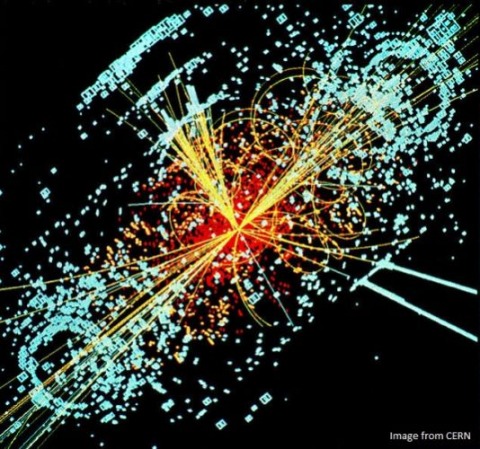 A Higgs boson particle walks into a Catholic church. Surprised, the priest asks, “what are you doing here?” The particle replies, “You can’t have mass without me!”