The Underground Thomist
Blog
Visible and InvisibleFriday, 12-19-2014In a famous talk some years ago, the philosopher Mortimer Adler delivered a lovely refutation of the modern fallacy that we never perceive anything in itself, but only perceive our idea of the thing. As he explained, the only thing I ever perceive is the thing, but I perceive it by means of the perception in the intellect. The classical thinkers called this the “intelligible species.” I do not actually perceive the idea at all – in Adler's term, it is "invisible" to me, like a perfect window. If I try to perceive the perception, all I am really doing is constructing a theoretical representation of it, which is neither the perception nor the thing itself. So the moderns have matters exactly backwards. Pondering this the other day I realized that the fallacy Adler discussed is loosely akin to a variety of other errors that crop up every day. To mention but a few -- 1. The mistaken notion that when I say that I cherish the beloved, what I mean is that I cherish the feeling that the beloved gives me. 2. The mistaken notion that the only thing I ever actually desire is pleasure -- not truth but the pleasure of grasping truth, not beauty but the pleasure of beholding beauty, not God but the pleasure of feeling I know God. 3. The mistaken notion that in order to find myself, I must seek and pursue myself, and that this is the main project of human life. Actually, 1. The only thing I ever really love is the beloved, and to the degree that I cherish my feelings instead, I am not truly loving her at all. The characteristic expression of love is that you are wonderful, not that I have wonderful feelings. 2. The good is indeed what I desire. Pleasure is merely the mode in which I repose in the experience of it. If I focus on my pleasure instead of the good thing, I am no longer experiencing the thing itself, and so most of the pleasure is destroyed. Thus, I am most joyful, not when I am thinking of my joy, but when I am thinking of the thing that causes me joy. 3. In order to find myself I must lose myself. What I catch, when I seem to catch myself, is not my true self, but only my representation of myself, which may be quite distorted. My true self is most fully actual not when I am pursuing myself, but when I am pursuing the things that a being like me is made to pursue. I am most who I am when I forget myself in the light of what transcends me.
|
Libertarianism as the Liberalism of the RightThursday, 12-18-2014Conversation took an interesting turn with a few lively political philosophy undergrads who liked, or thought they liked, self-government and free markets. I suggested that institutions such as the republic and the free market can’t function properly without virtue. They enthusiastically agreed. I suggested that these institutions cannot provide themselves with virtue – it has to come from somewhere else. Like schools? they asked. No, I suggested, schools can’t compensate for disordered families. At best they reinforce the lessons of sound ones. After considering the claim, again they agreed. And families, I suggested, won’t be healthy unless Mom and Dad remain faithful to each other. Right! Right! And that won’t happen unless we give up the idea that sex is an amusement unrelated to turning the wheel of the generations. Dead silence.
|
Upstairs MoralityWednesday, 12-17-2014
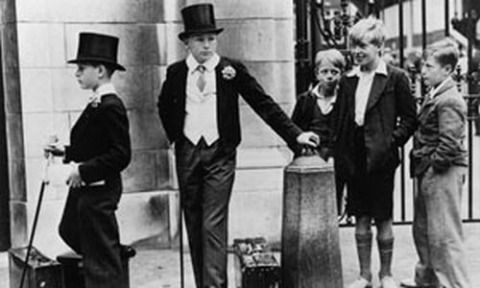
Liberalism is an "upstairs" morality, much as “playing the game" and "good form" used to be in the English upper classes. Its chief function is to enable our intellectual, professional, and business classes feel virtuous, while at the same time disguising the political mistreatment of the other classes. Its adages of not “judging” anyone and being “neutral” among conceptions of how to live are in turn disguises for its judgment that the notions of ordinary people are defective, and that their conceptions of how to live are wanting.
|
Getting In a Mess and Getting OutTuesday, 12-16-2014
More than once after giving a talk, I’ve been asked, “How did we get into this mess?” People pose this question in the hope of a simple answer. There isn’t one. No one thing got us into this mess; we were brought here by a great many seemingly independent but converging and reinforcing events, over a period of centuries. Some were epistemological, like how wisdom was displaced by expertise. Some were political, like how technocrats who said they would end social misery found it in their interest to promote a permanent underclass of dependents. Some were psychological, like how the revenge of conscience came to be such a powerful motor of social disintegration. Some were social, like how vulgarity came to be viewed as a mark of perverse sophistication. Some were theological, like how the doctrinal effect of the sola scriptura maxim was precisely the opposite of what was intended. Some were philosophical, like how we put out our eyes rather than recognize and honor the meanings and purposes woven into us. Are you discouraged? I’m not. The very fact that we can enumerate these many tangles means that the untangling is cut out for us. Leave decent people to their imperfect common sense. Abandon the self-righteous nostrum that the best way to help the poor is to undermine them. When you have sinned, don’t reinvent morality; repent. Whatever is true, honest, just, pure, lovely, gracious, noble, and worthy of praise, feast your mind on it. Respect Tradition. Open your eyes.
|
What We Can Do, Even When It Seems There Is Nothing We Can DoMonday, 12-15-2014Often, even if we cannot prevent something from happening, we can do something about how it will happen. I think Alexis de Tocqueville had the right idea about this. The particular spectacle that held him in a trance of fascination was the world-wide disappearance of the old social order with its inherited social ranks, and its replacement by a new social order with equality of social ranks. We democratic souls are hard on the vices of the old order, and nearly blind to those of the new. With a clearer vision of the virtues and vices of both orders, Tocqueville was tempted to nostalgia for what was passing. Yet he thought it would be both futile and impious to seek the old order’s preservation, because he believed that for reasons obscure to us, God had ordained its demise and replacement. What then? Did he say, like the Stoics, that we are helpless to choose what happens, free only to choose our attitude toward it? No, Tocqueville was a Christian. He reasoned that although we cannot prevent disappearance of the aristocratic social order even if we wanted to, it does lie within our power to decide which form the new order will take: Whether we will pursue our desire for equality of ranks by pulling down the high, or by raising up the low. Extend that thought. In every age of society, known goods and evils are disappearing, while new and perilous potentialities are arising. What emerges from these chances, for good or ill, is not fixed. It is always possible to choose the pure, the true, and the beautiful. And though more difficult, it is always possible to refuse complicity in their opposites.
|
Annals of LimerickSunday, 12-14-2014
I have a half-baked theory that people in different disciplines are attracted to different kinds of jokes. Physicists seem to be especially fond of limericks: There was a young lady from Bright, Whose speed was much faster than light. She set out one day In a relative way, And came back on the previous night. Perhaps philosophers too. For what it’s worth, here is one of my own coinage: To a Cartesian thinker named Duzz There came a most fabulous buzz: "For I not only think, But I also have thought. So I not only am, but I was." Are there any Thomistic limericks? There ought to be. The angelic doctor staunchly approved "words or deeds wherein nothing further is sought than the soul's delight," saying "man's mind would break if its tension were never relaxed." I know a near-limerick by St. Thomas himself. In a prayer of thanksgiving he wrote for use in Mass, the middle sentence asks “May [the sacrifice] purify me from sin, do away with my evil desires and passions, bring me charity and patience, humility and obedience, and strengthen me in all virtue.” The great Catholic apologist, Msgr. Ronald A. Knox, pointed out in 1925 that this uplifting petition has a limerick’s pattern of rhymes -- though not quite a limerick’s rhythm (which would have sounded cheeky in a prayer!): Sit vitiorum meorum evacuatio, Concupiscentiae et libidinis exterminatio, Caritatis et patientiae, Humilitatis et obedientiae, Omniumque virtutum augmentatio. If you do know any Thomistic limericks, let me know. There are only two rules: They have to be funny, and they have to scan.
|
Fragment from an Earlier CivilizationSaturday, 12-13-2014First freedom meant our noble power of rational and moral self-direction. Then it meant the mere absence of restraints on our will, so long as we were not violating moral law. Then it meant the absence of any restraints whatsoever. Finally it meant the sheer power to act immorally and irrationally, even if the power of rational and moral self-direction were taken from us. Insofar as this is an illness of the mind, even to recognize its progress is to begin its cure. Insofar as it is an illness of the heart -- Here the manuscript breaks off.
|